Elara's Trust
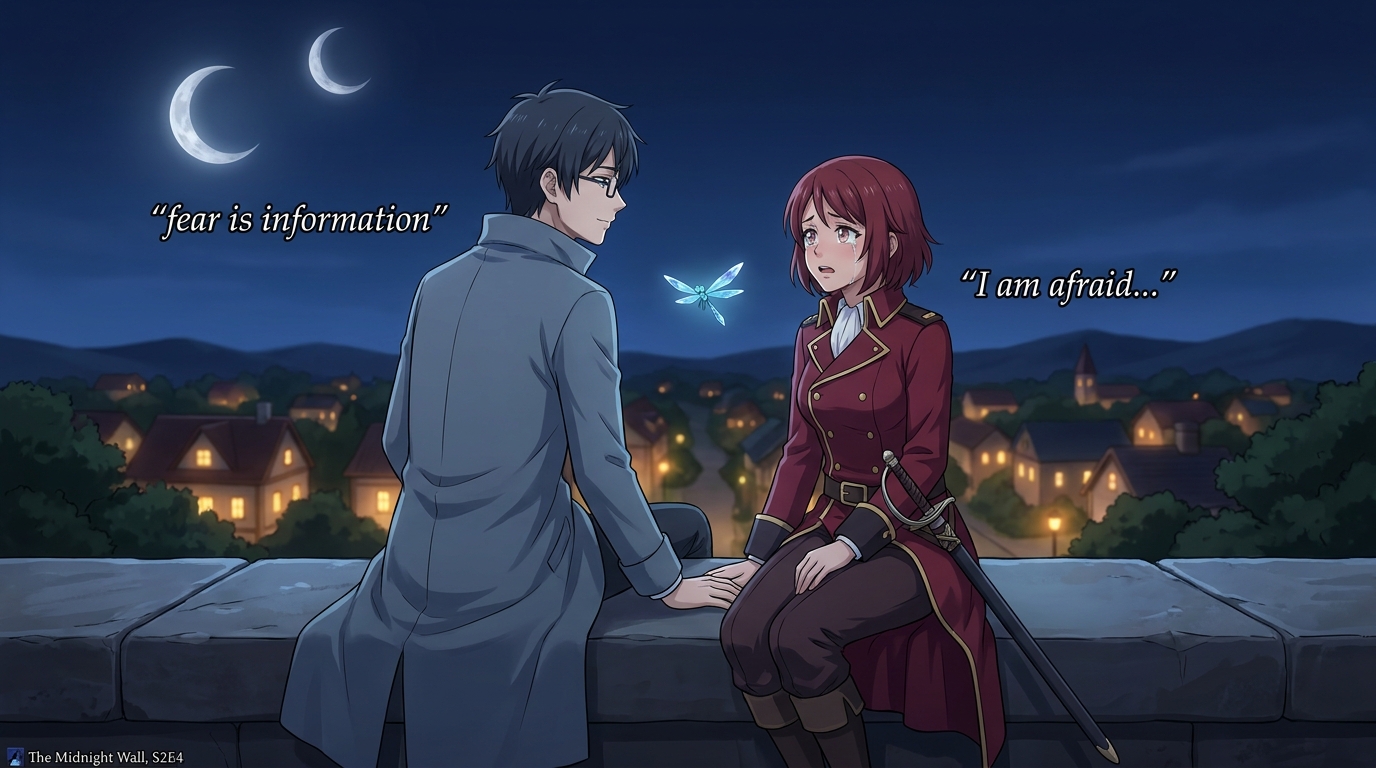
In which our protagonist learns that the woman he has been slowly falling for is afraid, and is asked to do something about it.
Elara asked him to walk the walls at midnight, in the captain's briefing that morning, in front of the entire town guard, in the same flat voice she used to ask for the daily patrol rotation.
"Kenji, walk the walls with me tonight."
She did not explain why. She did not say what she wanted to talk about. She moved on to the next item, as if it were a routine patrol. The guards, who were used to Elara's economy of language, did not react. The mayor, who was visiting the briefing for the first time in a month, did not react. Only Kenji, who had been in Oakhaven for three months and had been including her in briefings for two, heard the difference.
It was not a routine patrol. Elara had never, in three months, invited him on a routine patrol. She had invited him to briefings. She had invited him to council meetings. She had invited him to inspections. She had not, until this morning, invited him to walk the walls at midnight, when the town was quiet and the stars were out and there was no one to overhear.
He went.
The walls of Oakhaven were old, made of fitted stone, wide enough for two to walk abreast. Elara was already there when he arrived, leaning on the parapet, looking out at the dark fields. She had her sword at her hip and her notebook in her belt, but she was not writing. She was just standing.
"You came," she said, without turning.
"You asked."
"I ask a lot of people to do a lot of things. Most of them find reasons to say no."
"I am a software engineer. We do not say no to debugging requests. We say 'let me look at it.'"
That got a small sound from her, almost a laugh. "You are a strange man, Kenji."
"So I have been told."
They walked. The walls curved around the town, and from the highest point, you could see the dark shapes of the southern forest, and the small lights of the outlying farms, and the two moons hanging low in the sky.
"I am afraid," Elara said.
The words came out flat, matter-of-fact, the way she said everything. But they were, Kenji knew, the most honest thing she had ever said to him. He stopped walking. She stopped too. They were both looking at the moons.
"Of what?" he asked, quietly.
"Of losing the town. Of not being enough. Of making the wrong decision and watching people die because of it." She paused. "I have been captain for seven years. In that time, I have lost six people. Six guards. Six names in my book. Six families I had to tell. Six times I lay awake and asked myself if I had done the right thing."
[Compiler note: this is the senior engineer who has been asked to onboard a junior. The system is, in a small way, paying attention.]
[Compiler note: developer should not interrupt. The system is, in a small way, logging this for the record.]
The system was, in a small way, ahead of him. The system was, in the driest possible language, telling him to listen.
"Six out of how many total?" Kenji asked, softly.
"Probably a hundred and twenty guards over seven years. Some retired, some transferred. Six lost. That is a five percent casualty rate. By the standards of the southern border towns, that is excellent. By my standards, it is six too many."
She finally looked at him. Her eyes were steady, but there was something underneath, something she had been carrying for a long time.
"The cult is coming," she said. "I can feel it. The reports from the south are getting worse. The droughts, the raids, the strange symbols. They are organized. They are patient. They are coming here. And when they come, people will die. Maybe a lot of people. Maybe people I know. Maybe people I love."
She said the last word very quietly, and looked away.
"Elara," Kenji said. "You are not alone."
"I know."
"You have me. You have Lian. You have the mayor, the engineers, the town guard, the merchants. You have three hundred miners who just got their jobs back. You have two thousand people who are alive right now because you made the right call on the aquifer. You are not alone."
"I know," she said again. "But I am still afraid."
Kenji thought about it. He thought about his old job, about the projects that had gone wrong, about the times he had lain awake wondering if he had made the right call. He thought about the way fear and responsibility braided together, the way being good at your job did not make the fear go away, it just gave you something to do with it.
"Fear is not the problem," he said. "Fear is information. It tells you what matters. The problem is what you do with it. You use it to plan. You use it to prepare. You use it to make sure that the people you love are safe."
"And if I fail?"
"Then you fail. And you get up. And you try again. That is the only thing any of us can do."
Elara looked at him for a long moment. Then she nodded, slowly, and said: "You are not what I expected, Kenji."
"What did you expect?"
"A mage. A scholar. A strange foreigner with strange magic. Not someone who walks walls at midnight and talks about fear."
"I am a software engineer. We walk walls at midnight and talk about fear. It is in the job description."
That got a real laugh this time, soft and surprised. She turned to him, and for the first time since he had met her, Elara Vance looked like a person and not a captain. She looked tired, and scared, and a little bit hopeful, and she looked, in the moonlight, like someone he could love.
She did not say it. He did not say it. They stood on the wall and looked at the moons for a long time, and the night went on, and nothing happened, and everything happened.
[Compiler note: relationship status update. Logs: previous category "professional respect." New category: open.]
[Compiler note: the developer is, in a small way, learning. The system is, in a small way, ahead of the developer.]
The system had, in a small way, logged it. The system was, in a small way, ahead of him. The system was, in the driest possible language, telling him what he was not yet ready to admit: that the person standing next to him on the wall, looking at the moons, was going to be in his life for a long time, and that the kind of love they were going to build was going to be the kind that holds.
When they finally walked back to the guard house, Elara said: "Thank you."
"Anytime," Kenji said.
"I mean it. Thank you. I have not talked about this with anyone. Not my guards, not the mayor, not anyone. I needed to talk about it, and you listened."
"That is what I do. I listen, and I think, and I try to help. It is, in a way, my purpose."
She smiled. It was the first full smile he had seen from her, the kind that reached her eyes, and it was like watching the sun come up.
"Goodnight, Kenji."
"Goodnight, Elara."
He walked back to the guild hall, Pip orbiting his head, and Pip pulsed, very softly, and the pulse felt like: "You did well."
Kenji sent back: "Thanks, partner."
Pip pulsed again. The pulse felt like: "She is going to be important. In ways you cannot yet see."
Kenji did not ask what Pip meant. He was, in the driest possible language, a developer who had learned to trust his own system, and the system was, in a small way, ahead of him.
He climbed the stairs to his room. He took off his shoes. He lay down on the bed, and the notebook Elara had been carrying was, he realized, the same kind of notebook that Lian carried, and the same kind of notebook he had carried in his old life, the kind of notebook that holds the things you cannot say out loud. Elara's notebook was going to hold the names of the lost, and the dates of the sieges, and the quiet details of a life spent defending walls, and the notebook was going to be the seed of a much larger network, in a much harder time, when the captain of the guard would be running intelligence for a kingdom.
He did not know that. He knew only that she had said people I love, and that the word had been small, and the word had been huge, and the word had changed everything, and the night was not over yet, but the night was, in a small way, ahead of him.