The Cultists Strike
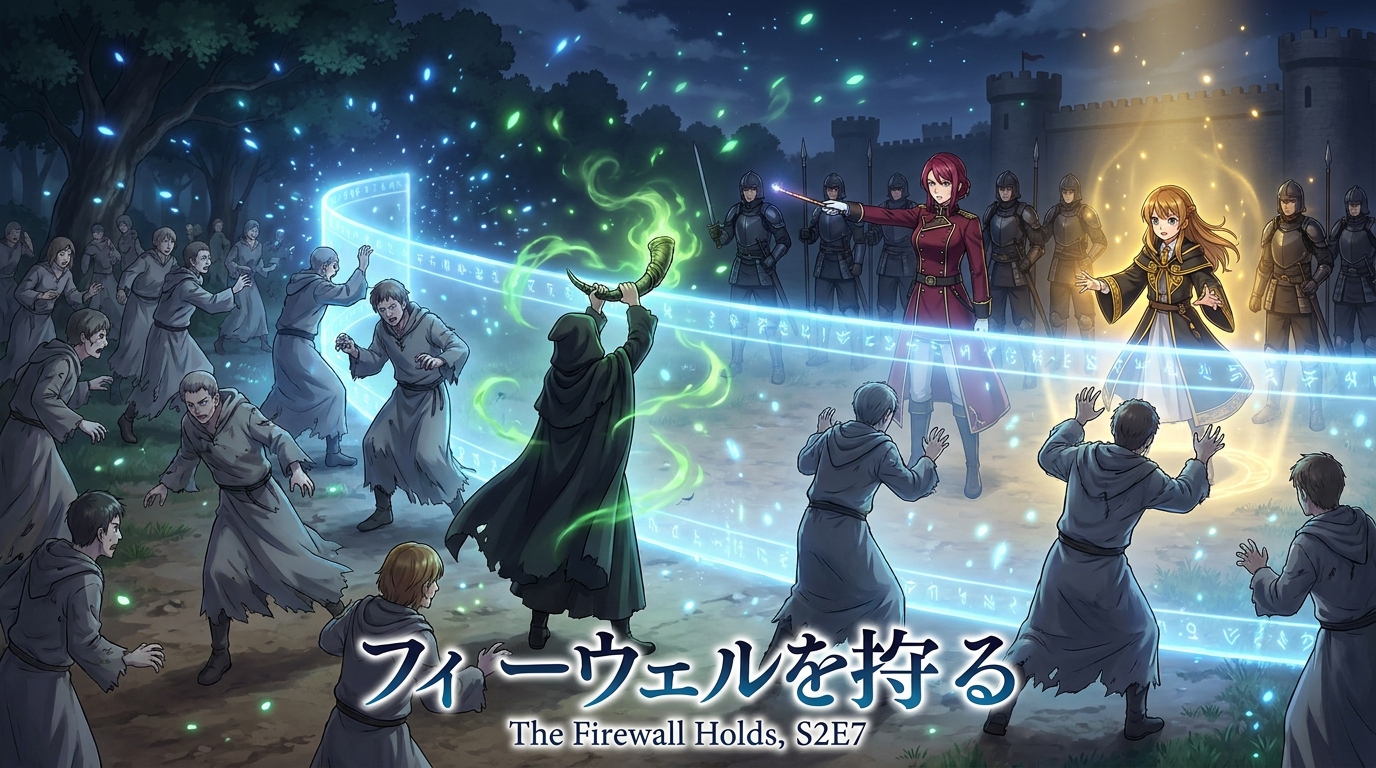
In which our protagonist's firewall spell is tested in combat, and the clock tower is attacked.
They came on the third night, and the first thing Kenji heard was the horn, and the horn was not the kind of horn that meant important person coming. The horn was the kind of horn that meant kill the alarm before it kills you.
The note rose into the air, brassy, mournful, the same sound that had been haunting the southern reports for weeks, the same sound that the scouts had heard in the cult camps, the same sound that Pip had been warning about for two days.
[Threat assessment: dimensional intrusion, cult-marked]
[Targets: clock tower (primary), water reservoir (secondary)]
[Compiler note: the apprentice's firewall is the only defense available. The system is, in a small way, hoping she is ready.]
Kenji was already running for the south wall, Pip screaming in his ear, and behind him Lian was running too, her face pale, her hands already half-raised in the casting posture, and Elara was on the wall ahead of them, sword drawn, calling out positions to the town guard in a voice that was, in the dry language of the system in his head, the voice of a person who had been training for this her whole life.
"How did you know?" Elara had asked him, two days ago, when he had insisted on doubling the south wall guard and putting Lian on standby.
"Because I have been listening to the reports from the south," he had said. "Every cult attack has been at night. Every cult attack has used the horn. They are ritualized. They are predictable. They are also, in their own way, software engineers. They have a process. We can debug it."
She had stared at him for a long moment. Then she had said: "I will post double guards on the south wall. You and Lian will be ready with the firewall. The mayor will be in the town hall. The civilians will shelter in place."
"You have done this before."
"I have done this many times. Not against the cult, but against bandits. The principle is the same. Predict, prepare, respond."
[Compiler note: this is the senior engineer who has been asked to onboard a junior. The system is, in a small way, paying attention.]
[Compiler note: the captain's principle is sound. The system approves.]
So they waited. And at the third hour of the third watch, the horn sounded.
It came from the south. A single, long, mournful note that rose into the air and hung there, as if the world itself was holding its breath. Then it sounded again. And again. Three notes, in a pattern, the kind of pattern that Kenji recognized from his days debugging signal systems: an alert, a direction, a target.
The target was the clock tower.
Kenji saw them coming out of the tree line. Grey robes, moving in formation, maybe forty of them, walking with the eerie calm of people who believed they were doing the right thing. They did not run. They did not shout. They walked, in step, their robes swaying, and at the front of the formation, a figure in a darker robe was carrying something that glowed with sickly green light.
The horn, Kenji realized. That was the horn. It was not a signal instrument. It was a mana artifact, and the sickly green light was the cult's corruption made visible.
"Firewall," he said, to Lian.
She was already casting. The pale blue wall shimmered into existence across the southern approach, twenty meters wide, three meters high, humming with stability. The first cultists hit it and stopped, confused. The wall did not just block magic. It blocked mana. They could not cast through it, could not dispel it, could not even touch it without losing the mana in their hands.
[firewall: ACTIVE]
[mana draw: 22% of caster pool per minute]
[Compiler note: the apprentice is, in a small way, magnificent.]
The dark-robed figure raised the horn. The green light flared. The wall held. The cultists fell back, regrouped, and then they did something Kenji had not expected.
They split. Half of them turned east, half of them turned west, and they started running around the wall.
"They are flanking," Elara said, sharply.
"They are not flanking. They are doing what we would do. They are looking for a node to break the spell. The firewall is a system. The system has endpoints. If they can find the endpoint, they can break it."
"Where are the endpoints?"
"Here." He pointed to where Lian was standing. "And here." He pointed to himself, at the other end of the wall. "The firewall is anchored to two casters. If they take one of us out, the wall collapses."
"Then we do not let them take us out."
"Yes."
The cultists came around the wall from both sides. The eastern flank hit a smaller firewall that Kenji had set up the day before, held by two of the town guards who had been practicing with Lian all week. The western flank hit the wall itself, where the rest of the town guard was waiting, swords drawn.
The fight was not long. The cultists were not soldiers. They were farmers, merchants, scholars, people who had been recruited with promises and fear. When they met actual steel, they broke. Half of them ran. Half of them fell. The dark-robed figure with the horn stood in the middle of the field, alone, the green light guttering, and then Pip screamed.
Pip had been quiet all night. Suddenly, urgently, the dragonfly pulsed, and the pulse was not a warning. It was a recognition.
"Stop," Kenji said, to Elara. "Do not kill that one."
The dark-robed figure looked at him. The figure was older, with a face that was neither young nor old, and eyes that were not quite human. The figure was the grey-robed watcher from the siege reports. The lieutenant. The one who had watched him from the shadows and reported to Malachar.
"You," the figure said. "The structured one."
"Me," Kenji said.
"The master wants you. He has wanted you since the clock. He has been patient. He will not be patient forever."
"I am not coming."
"Then the master will come for you. And when he does, the firewall will not be enough."
The figure raised the horn. The green light flared. The figure's body started to dissolve, the corruption eating it from the inside out, a final, desperate act of faith. The horn fell. The green light died. The figure was gone.
Kenji walked to where the horn had fallen. It was warm. It was humming, faintly, with the same kind of structured magic that he used, but twisted, wrong, like a function call with a corrupted argument.
[Object analysis: horn]
[Source: external, not native to this world]
[Note: this is a piece of the corrupted source code. The system is, in a small way, frightened.]
Pip landed on the horn. The dragonfly's pulse was soft, sad, and very, very careful.
"This is a piece of the source code," Kenji said, quietly. "This is what Malachar is. A corrupted function. A spell that has been broken for a long time."
He picked up the horn. It was heavy. It was also, he realized, the most dangerous object he had ever touched. It was, in a very real sense, the bug. It was the thing that the original programmer had written wrong, the way a system is written wrong when the engineer is grieving and the deadline is tomorrow and the code goes out anyway, broken, and the brokenness spreads, and the brokenness becomes the world.
He did not put it down.
The horn hummed in his hand. The horn was, in the driest possible language, a piece of the same code that the Compiler ran on, only twisted, only broken, only the part of the system that Malachar had, in a moment of grief a long time ago, decided to write without love. The horn was going to be the seed of a much larger problem. The horn was going to be the seed of a much larger understanding. And the horn was going to be, in a year and a half, the thing that summoned a piece of the void into the world, and the summoning was going to be the test that mattered, and the test was going to require a spell Kenji had not yet written.
Pip pulsed, very softly, in a tone that was, in a small way, ahead of him, and the pulse felt like: "You are holding the bug. The bug is not held. The bug is, in a small way, holding you."
Kenji did not put the horn down. He did not look away. He stood in the field, in the moonlight, with the dead grey robes around him and the firewall still humming and the apprentice still standing, and he thought about the through-line, and the through-line was, in the driest possible language, any sufficiently well-defined problem is solvable.
The bug was the problem. The bug was the problem that mattered. The bug was, in a small way, the whole story.