The Council of Kings
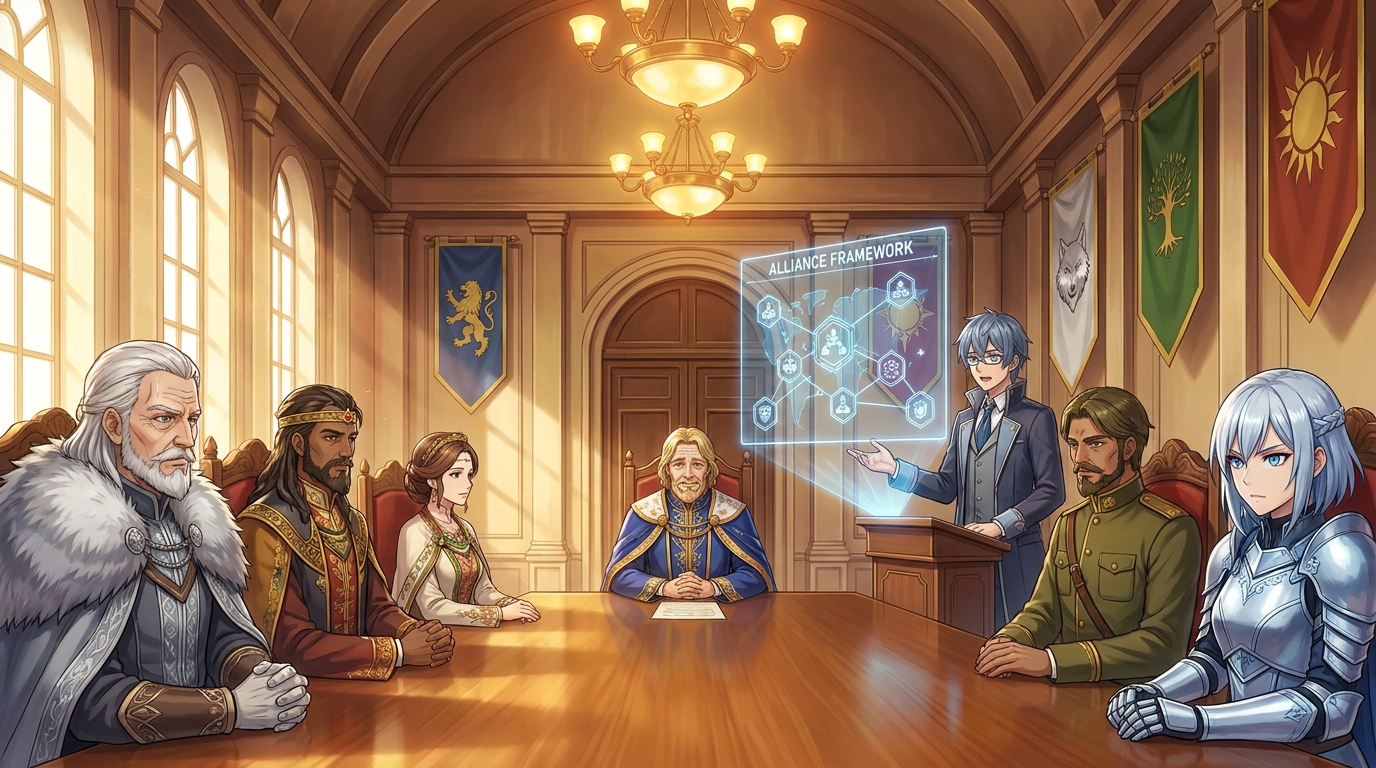
In which our protagonist proposes an alliance, the through-line gets its biggest deployment yet, and a princess decides to watch him more carefully than he would like.
The Council of Kings met in the great hall of the central kingdom's palace on a cold morning in late autumn, and the seven kings who arrived were, in the driest possible language, the seven people on the continent who least wanted to be in the same room with each other, and the seven people who, the developer had decided, were going to be the seven people who debugged the world together, or the seven people who were going to fail together, and the system was, in a small way, hoping it would not be the second one.
Theodore sat at the head of the table, the host, the senior partner, the king who had been dealing with the corruption longest. King Haldor of the north had sent his daughter, Princess Calla, in his place, because the old man was tired, and because the old man had decided, in the way that old kings decide, that the princess was going to be a better representative than the king, and because the old man was right. The three southern kings had stopped fighting each other, because the cult had finally given them a common enemy. The eastern king had brought his entire court, because the eastern king did not trust anyone, including himself. The queen of the west had brought only herself, because the queen of the west did not need a court, and the queen of the west was, in the driest possible language, the kind of person who, when she walked into a room, made the room smaller.
They sat around a long table. They looked at each other with the careful suspicion of people who had been rivals for a long time and were not sure if the new threat was bigger than the old rivalries. The system logged their heart rates. The system did not, in fact, comment on them. The system was, in a small way, paying attention.
Kenji stood at the head of the table. He was tired. He was running on four hours of sleep. He had a small glowing dragonfly orbiting his head. He was, by every visible measure, the least impressive person in the room. He was also, by the only measure that mattered, the person who knew what the bug was.
"The storms are not natural," he said. "The earthquakes are not natural. The corruption is not natural. They are all symptoms of a single process that is running in the world's source code. The process is called Malachar. It is a chaos god. It is not a person. It is a bug."
The room was quiet. The room was, in the driest possible language, the kind of room that the system was, in a small way, monitoring for noise levels, and the noise level had just dropped below the threshold of a normal council chamber, and the threshold of a normal council chamber was, in a small way, the threshold of a room in which someone has just said something that nobody in the room was expecting to hear.
[Council session: open]
[Attendees: 7 royal representatives, 1 Strange Sage, 1 familiar, 1 system]
[Status: listening]
[Compiler note: this is the senior engineer who has been asked to onboard a junior continent. The continent is, in a small way, paying attention. The system approves.]
"The bug is generating storms, earthquakes, droughts, and corruption. The bug is contagious. The bug is spreading. The bug will continue to spread until the source code is debugged."
"How do we debug the source code?" the queen of the west asked, and the question was, in the driest possible language, the question of a person who had decided, before she had walked into the room, that she was going to ask the first question, and the question was the kind of question that the system was, in a small way, logging as a positive signal.
"We coordinate. We share resources. We share mages. We share intelligence. We share the crystal network. We do not fight each other. We fight the bug. We treat this as a war, but a war against a process, not against an army."
"You are asking us to form an alliance," Princess Calla said. She was young, mid-twenties, with sharp eyes and a calm voice, and she was the kind of person who said "I have decided" more than "I can," and the kind of person who, when she looked at the developer, looked at the developer in a way that the developer was, in a small way, noticing more than he would have liked. "An alliance of seven kingdoms, coordinated through a mage's crystal network, to fight a god."
"Yes."
"Why should we trust each other?"
"You should not trust each other. You should trust the system. The system has audit spells, mana signatures, and crystal communications. Every transaction is traceable. Every action is verifiable. Trust is not required. Verification is."
The room was quiet for a long time. The system logged the silence. The system was, in a small way, the kind of system that logs silence, because silence is, in the driest possible language, a signal, and the signal was, in a small way, the signal of a room that was, in fact, considering the proposal.
[Audit spells: available]
[Verification framework: ready]
[Compiler note: trust is not required. Verification is. The system approves. The system is, in a small way, ahead of the developer.]
Then the queen of the west said: "I am in."
The eastern king said: "I am in, but I want a seat on the council."
The southern kings said: "We are in, but we want reparations for the cult's damage."
The northern princess said: "I am in, but I want to know who is in charge."
Kenji looked at King Theodore. Theodore looked at Kenji. The king's face was tired, but his eyes were bright, and the brightness was, in the driest possible language, the brightness of a person who had been waiting, for a long time, for someone to say the thing that the king had not been able to say.
"King Theodore is in charge of the alliance," Kenji said. "He is the senior partner. He is the host. He is the one who has been dealing with this longest. He is the one whose kingdom is the most stable. He is, in the language of my old job, the lead developer."
Theodore stood. He said: "I accept. But I want to be clear. This alliance is not about me. This alliance is about the debugging. We are all of us, kings and mages and refugees and guards, part of the same system. The system is broken. We fix it together. Any sufficiently well-defined problem is solvable, but only if we solve it together."
[Alliance: formed]
[Member kingdoms: 7]
[Verification framework: active]
[Through-line: restated]
[Compiler note: any sufficiently well-defined problem is solvable. The system approves. The developer is, in a small way, learning to scale.]
The room was quiet. The through-line was in the air. The through-line was, in the driest possible language, the spine of the developer's life in this world, and the spine had just been quoted by a king, in a council chamber, in front of seven kingdoms, and the system was, in a small way, proud of the developer for having said the thing that the king was now able to say.
Princess Calla, at the far end of the table, was looking at Kenji with an expression he could not read, and the expression was, in the driest possible language, the expression of a person who had decided, in the smallest possible words, that the person at the head of the table was a person who was going to be important, and the person who was going to be important was, in a small way, going to be a problem.
Kenji walked out of the great hall, with Elara on one side and Lian on the other, and Pip orbiting his head, and the kings behind him, and the alliance ahead of him, and the through-line ringing in his ears, and the system was, in a small way, the kind of system that does not let the developer finish a sentence before the next bug arrives, and the next bug was, in a small way, already on the way.