The Broken Clock
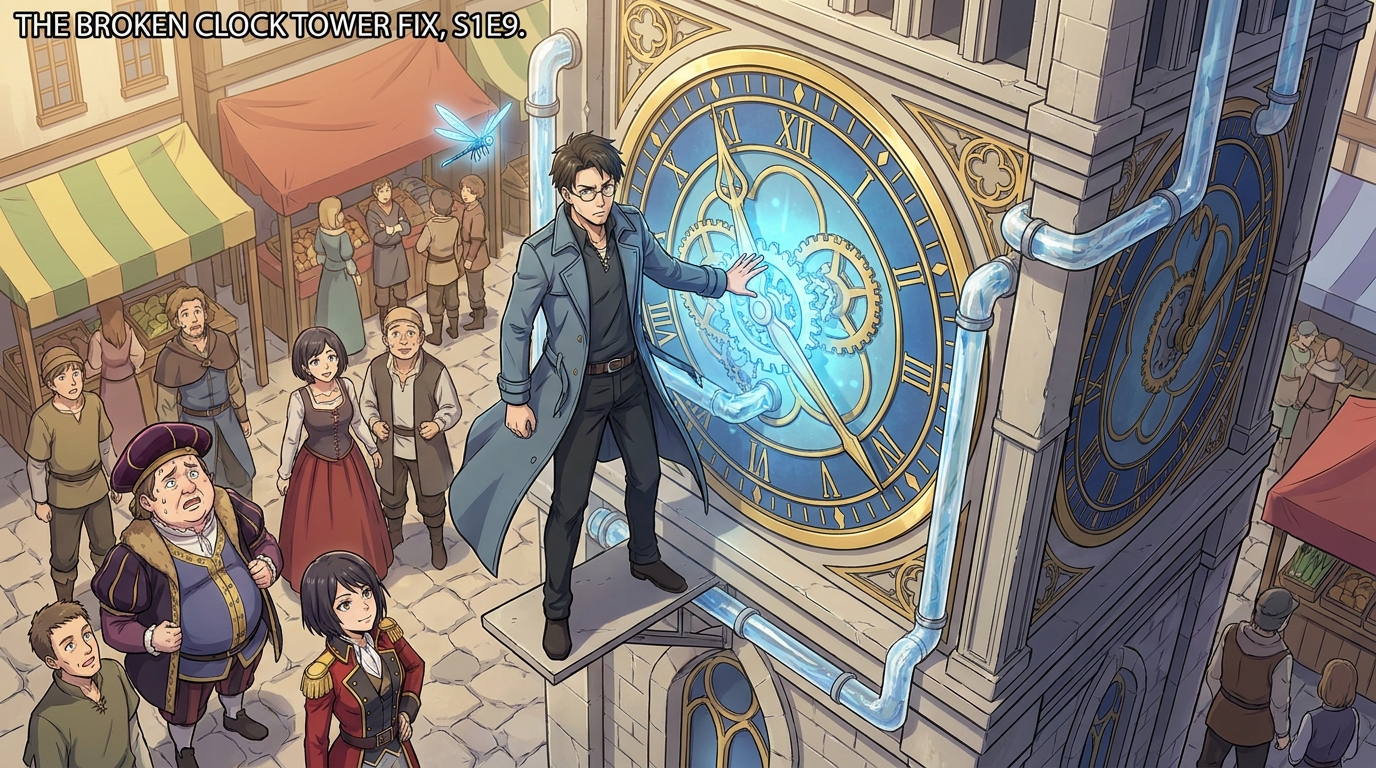
In which our protagonist fixes an infrastructure problem and discovers he is, fundamentally, the same person he always was.
The town clock had been broken for two years.
It stood in the center of the market square, a tall stone tower with a large clock face on each side. The clock face was a beautiful thing, painted blue and gold, with brass hands and intricate numerals. The mechanism inside was a mess. A water-wheel-driven system, the kind of clever, semi-magical engineering this world used for everything, had fallen into disrepair, and no one in Oakhaven had the skill to fix it.
The mayor had asked three different engineers from three different cities. All had failed. The clock sat silent, and the town lived by the sun and the church bells.
Kenji, who had spent the last two days in a borrowed room, surviving on Orven's charity and the polite suspicion of the townsfolk, was walking through the square on the morning of the second day when he saw it.
The clock face, the empty mechanism, the tower. He stared at it for a long time. The Compiler was already analyzing the system, drawing on Pip's cached observations of similar water-wheels, and offering him a tentative model of how the clock was supposed to work.
It was, he realized, exactly the kind of problem he used to solve at his old job. Not the magic. The architecture. The system was failing because a single component was misaligned, and no one had thought to check the input.
"I can fix this," he said, out loud, to no one in particular.
A passing merchant overheard him. Then a guard. Then a small crowd, because in a town of three thousand, news traveled at the speed of gossip, and by noon, Kenji was standing at the base of the clock tower with Mayor Aldric, Captain Elara, three engineers, and a small mob of curious townsfolk.
"You can fix the clock," the mayor said. He was a portly man, nervous, with the perpetual expression of someone who was about to be disappointed.
"Probably," Kenji said. "I need to see the mechanism."
"The mechanism is on the top floor. The stairs are narrow. Only one person can fit at a time."
"Then I'll go up. Bring me tools. A wrench, pliers, anything to grip. And a bucket of water."
The mayor looked at Elara. Elara looked at Kenji. "If you break the clock further, I will hold you personally responsible."
"Understood."
He climbed the stairs. The mechanism was exactly as the Compiler had predicted: a water-wheel connected to a series of gears connected to a regulator connected to the clock hands. The wheel turned too fast, the gears had worn down, the regulator was corroded, and the whole thing was running about thirty percent too fast, which had caused the brass hands to slip their mountings.
It would have taken a year of regular maintenance to keep it running. It had not received any. The system was not broken. It had been abandoned.
Kenji spent three hours up there, alone, with Pip orbiting his head and the Compiler providing marginalia. He cleaned the regulator. He realigned the gears. He added a small, clever innovation of his own: a mana-powered governor, a tiny spell that adjusted the water flow based on the clock's actual speed, ensuring the mechanism would not drift again.
It was, he thought, exactly the kind of cleverness that his old boss would have hated. It was also, he thought, exactly the kind of cleverness that made him a good engineer.
When he came down, the crowd had grown. The mayor was sweating. The engineers were looking skeptical. Elara was looking at him like he was a particularly interesting puzzle.
Kenji walked to the clock face and pushed the minute hand forward, manually, until it pointed to twelve. Then he whispered: "Function start(system='town_clock', input='water_flow', output='time', stability=high)!"
The mechanism inside the tower, dormant for two years, shuddered to life. The water flowed. The gears turned. The hands moved.
The clock, for the first time in two years, chimed noon.
The crowd erupted. The mayor looked like he might cry. The engineers looked at each other, looked at the clock, looked at Kenji, and started arguing in low voices. Elara walked up to him, looked at the clock, looked at him, and said: "That was not magic. That was engineering."
"Both," Kenji said. "Magic is just engineering that uses mana instead of electricity. The principles are the same."
Elara's mouth twitched again. It was, Kenji was beginning to realize, her version of a smile. "You have earned three months in this town. Free lodging at the guild hall, paid meals, and the goodwill of the mayor. Use them well."
"And after three months?"
"After three months, we will see. You may be a useful man to have around. Or you may be a problem. I have not decided yet."
"Fair enough."
She nodded, turned, and walked away. Kenji watched her go, and thought: "She is going to be a problem. The good kind, maybe, but a problem."
Pip pulsed, amused.
But Kenji was not done. He had fixed the clock, but the clock was a symptom. The town was full of systems that had been left to rot: the wells, the granaries, the watch rotation, the bridge over the southern creek, the irrigation channels. The mayor was overworked, the council was divided, the engineers were too proud to ask for help.
He found the mayor, who was still dabbing at his eyes.
"Your Honor. The clock is fixed. But I have been looking around, and there are a dozen other things in this town that need the same kind of attention. The wells. The granaries. The bridge. I would like to take a look at them, with your permission, and tell you what I find."
The mayor stared at him. "You would do this. For free."
"I am being paid in meals and lodging. I might as well earn them."
"Why?"
Kenji thought about it. He thought about his old job, about the satisfaction of untangling a system that had been broken for years, about the way a well-tuned mechanism felt when it finally ran the way it was supposed to.
"Because that is what I do," he said. "I take broken systems and I fix them. It is, in a way, my purpose. I am a software engineer. We cannot help ourselves."
The mayor, who had no idea what a software engineer was, took the statement on faith. He gave Kenji permission to inspect the town's infrastructure, and introduced him to the three engineers, who were now looking at Kenji with the suspicious respect of professionals who had been shown up by an outsider.
Kenji spent the next three days walking the town, the southern bridge, the irrigation channels, the granaries, the wells, the watch rotation, the alert system. He wrote reports. He drew diagrams. He proposed fixes. He did not, in those three days, sleep more than four hours a night.
And slowly, without anyone quite noticing, the strange foreigner with the glowing dragonfly became a fixture. The man who fixed things. The man who did not drink, did not gamble, did not cause trouble, but who, when asked, would quietly do something impressive.
Elara noticed. She did not comment. But she started including Kenji in the captain's briefings, listening to his analysis, occasionally accepting his suggestions. It was not friendship. It was professional respect, the kind that could, with time, become something else.
It was, Kenji thought, a start.
# WORLD.md (updated)

## Status
- Fixed town clock
- Earned three months of lodging and meals
- Made an impression on the mayor (good) and Captain Elara (mixed)
- Have not yet figured out which is harder to please
- Inspected town infrastructure. Found problems. Many problems.

## Lessons Learned
- A mana-powered governor is a hack, but it works
- The same engineering principles apply in any world
- People will love you for fixing their infrastructure
- Doing one good thing invites more good things
- Captain Elara is the real power in Oakhaven

## Reputation
- Local: "the strange foreigner who fixed the clock"
- Spreading: "the man with the dragonfly who does the impossible"
- Elara: "potentially useful, definitely weird, watch this one"