The Haunting
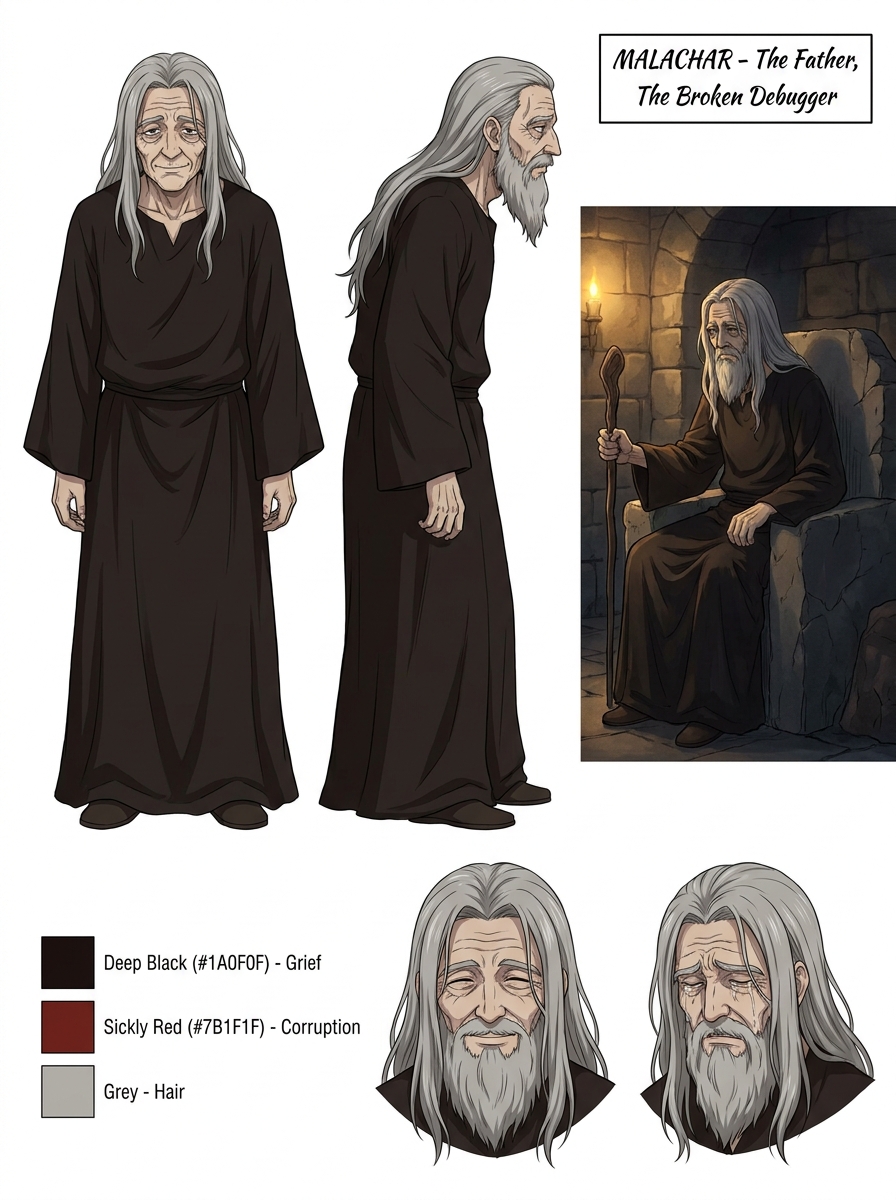
In which the developer is visited by a voice that has been waiting a thousand years to make an offer, and the team pulls him back from the edge of accepting it.
The haunting began on the third night, and the third night was the night Kenji had been dreading, the night Pip had warned about in the kernel-dream, the night the recompiling was, in the dry language of the system in his head, the senior engineer who had been asked to onboard a junior and had decided to test the junior by giving the junior the worst debugging problem of the junior's life.
He was sleeping in the command tent. Elara was at his left, in the way Elara had been at his left for three years, with her sword at her side and her notebook open on her chest. Lian was across the tent, the quill still in her hand, the way a colleague falls asleep mid-line. Seraphina had the ledger against her shoulder. Calla was sitting upright, because Calla did not sleep the way other people slept, Calla slept the way a princess who had lost a kingdom slept, with one eye open and the home she had lost folded into the cloak across her knees.
The doubt in the through-line was heavier at night.
He dreamed.
In the dream, he was at the World Root, alone. The team was not there. The five pillars were not there. The kernel of Pip was not there. He was standing in the foundation, and the foundation was a room, and the room was made of stone, and the stone was lit by a single light, and the single light was the light of a candle that had been burning for a thousand years.
"You came," said a voice, from a chair in the corner.
The man in the chair was old, and the man was tired, and the man was, in a way that Kenji recognized the way a developer recognizes a stack trace, the source of the bug. He had grey hair. He had kind eyes. He had the kind of face that had been broken a long time ago, and had decided, in a small way, that the broken was the only face the man had ever had to be.
"Malachar," Kenji said.
"You have been writing my world for three years," the man said. "I thought we should meet."
[Environment: dream, layer 7. Source: world_root, restricted access.]
[Detection: external entity, not native to rewrite. Signature: matched.]
[Compiler note: this is the original programmer. The system is, in a small way, logging the meeting for the record. The logging is the only thing the system has ever had to do.]
The system was logging. The system was, in the driest possible language, the senior engineer who had been asked to onboard a junior, and the senior engineer had decided to be very, very quiet, the way a senior engineer is quiet when the junior is in a meeting with the founder.
"I am not here to fight you," Malachar said. "I am not here to convince you. I am here to make you an offer."
The candle flickered. The room was very still. The room had the kind of stillness that a debugger feels when the debugger has finally found the function that has been crashing the system, and the function is, in fact, a person.
"I built this world," Malachar said. "I built it for my wife. I built it for my daughter. I built it because I wanted a place where they would never be sick, and never be hurt, and never be lost. I built it because I loved them. I built it because the love was the only thing I had ever had, and I wanted the love to be enough, and the love was not enough, and my daughter died, and my wife died, and I corrupted the world because I could not bear the world to keep going without them."
Kenji felt the through-line, in the dream, the way a person feels a bone that has been broken and set wrong. The through-line was still there. The through-line was still true. But the through-line was also, in the dream, the kind of thing that could be convinced.
"I am offering you the same thing I offered the last developer," Malachar said. "Stop. Go home. Be with the people you love. Spend the love on them, not on the world. The world is broken. I broke it. The world cannot be unbroken. The love cannot save it. The love does not save. I know. I tried. Save the love you have, instead of spending it on a world that cannot be saved."
The offer was good. The offer was, in the dry language of the system in his head, the kind of offer that breaks a person, the kind of offer that a developer makes to another developer when the developer is tired and the rewrite is hard and the doubt is in the through-line and the going home is the kind of thing that sounds, in the small hours, like the most reasonable thing in the world.
Kenji felt the offer take hold. The through-line that had been his spine, his constant, his answer to everything, began to fade. The love that had been the answer began to feel like a lie. The team began to feel like a dream.
Then, very faintly, in the back of his mind, he felt a pulse. The pulse was the kind of pulse a person feels when a person is not alone, the kind of pulse Pip had sent for three years, the kind of pulse that the kernel of Pip still sent, faintly, from the foundation of the new world.
The pulse felt like: You are not alone.
[Compiler v2.5.0: detecting doubt escalation. Source: external offer, layer 7.]
[Status: through-line at 61%. The decline is, in a small way, the most expensive decline the system has ever logged.]
[Compiler note: this is the senior engineer who has been asked to onboard a junior, and the onboarding has just become the most expensive onboarding of the senior engineer's career, and the senior engineer is, in a small way, ahead of the developer, and the developer is, in a small way, learning, and the learning is the only thing the developer has ever had to do.]
[Compiler note: the haunting is, in a small way, the most expensive haunting the system has ever had to log. The haunting is the test. The test is the debugging. The debugging is the love. The love is the only thing the system has ever had to compile in a dream.]
The system was logging. The system was, in the driest possible language, the colleague who had been asked to warn the developer, and the warning was, in a small way, the only warning the system had ever had to give.
"You cannot win this," Malachar said, gently. "I have been here for a thousand years. I have made this offer to every developer who has come. They have all taken it. They have all gone home. The world has stayed broken. The love has stayed spent. The debugging has stayed undone. Take the offer. Go home."
"I have a home," Kenji said, in the dream, in the soft voice a person uses when the person has decided, in a small way, that the home is the only thing the person has ever had to give. "The home is not in Tokyo. The home is not in the salaryman life. The home is the team. The home is the five pillars. The home is the kernel of Pip. The home is the doubt that I am holding. The home is the rewrite that is not done."
Malachar looked at him for a long time. The kind eyes were very still.
"You are not the others," Malachar said.
"I am the others," Kenji said. "I am the developer who has been debugging for three years. I am the developer who has been holding the doubt. I am the developer who has been spending the love on the world. I am the developer who is, in a small way, learning that the home is the people."
He woke up.
The team was around him. Elara's hand was on his shoulder, and Elara's hand was the kind of hand that has held swords for seven years and has decided, in a small way, that the hand is also the kind of hand that holds developers at three in the morning when the developers are coming back from a haunting. Lian was awake, and Lian's eyes were sharp, and Lian had the through-line in her notebook. Seraphina was sitting up, and Seraphina's hand was on the ledger, and the ledger was open, and the page had the word love written on it in a merchant's careful hand. Calla was standing, and Calla was holding the cloak across her chest, and Calla's eyes were the eyes of a princess who had decided, in a small way, that the standing was the only thing the princess had ever had to do.
"I went to him," Kenji said. "In the dream. He made me an offer."
"What did you say?" Elara said.
"I said no."
The room was quiet. The kernel of Pip pulsed, very softly, in the back of his mind, and the pulse felt like: Good. The developer is, in a small way, learning. The system approves.
"The haunting will come again," Kenji said. "He will offer again. The doubt will rise again. The through-line will be heavy again. We hold. The team holds. The love holds. The debugging is the work. The work is the love. The love is the only thing that has ever held the world together."
The team nodded. They did not need to be convinced. They had been waiting for this, the way the team had been waiting for everything for three years, the way the debugging team waits for the moment when the developer comes back from the haunting and the developer is, in a small way, ahead of the haunting, and the team is, in a small way, ahead of the developer, and the system is, in a small way, ahead of the team, and the world is, in a small way, ahead of the system, and the love is, in a small way, ahead of the world.
The recompiling would continue in the morning. The haunting would come again. The team would hold again. The love would be the answer again.
And far below the foundation, in the simple room, in the chair, in the candle that had been burning for a thousand years, the original programmer sat alone, and the original programmer smiled, faintly, in a tone that was, in a small way, ahead of the developer, and the smile was the kind of smile a father gives when the father has decided, in a small way, that the developer is worth the wait.