The Penetration
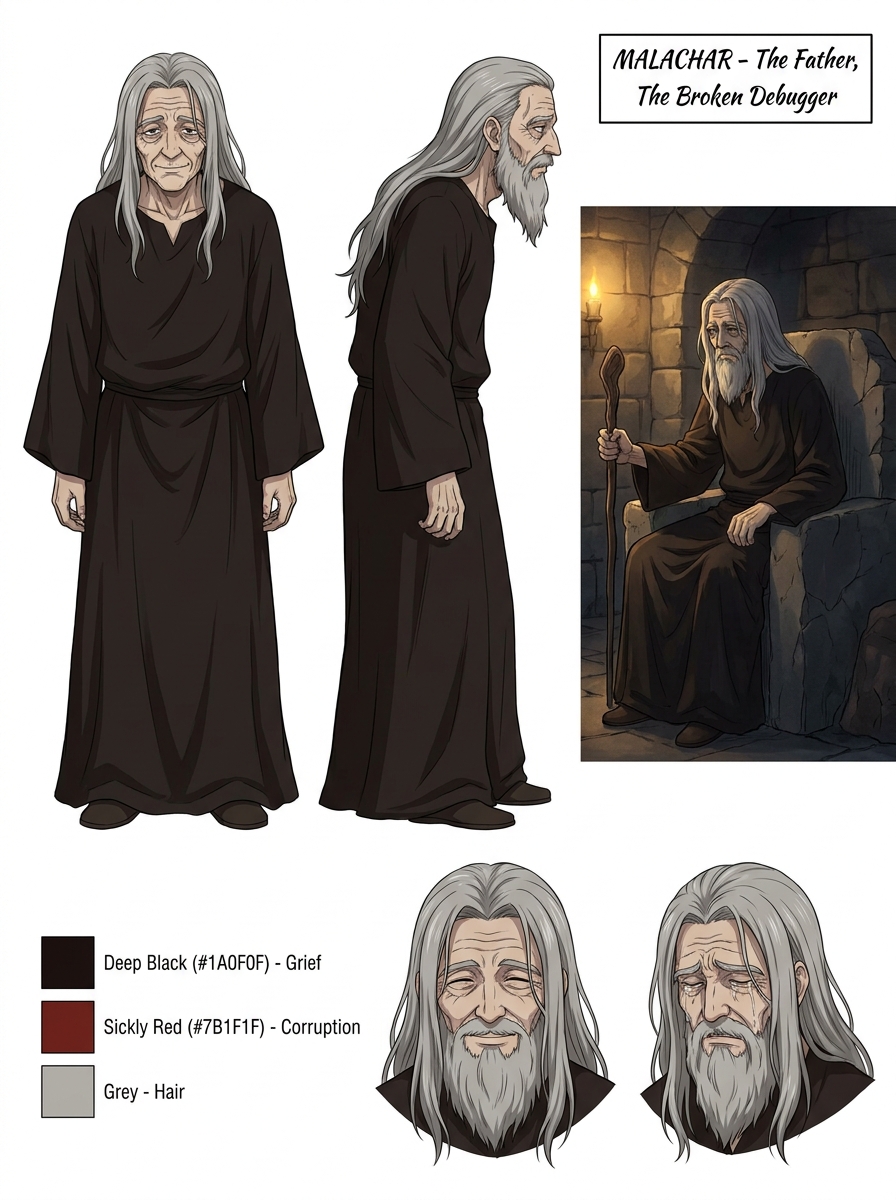
In which the team descends into the place where the original programmer has been waiting, and the chaos god turns out to be a man in a chair, and the man is, in a small way, ahead of the team, and the team is, in a small way, ahead of the man, and the debugging is the only thing the debugging has ever had to be.
The descent began on Monday, because Sundays were for deployment, and Mondays were, in the dry language of the system in his head, for the work the Sunday had made possible.
The team went down in the order the team had decided. Kenji at the front, with the kernel of Pip on his shoulder, the way a developer walks into a broken function with the debugger open. Elara behind him, with the memory, with the sword, with the notebook, with the kind of quiet a captain has when the captain is walking into a place the captain has decided, in a small way, the captain has always had to walk into. Lian behind Elara, with the quill, with the architecture, with the through-line, with the kind of focus a colleague has when the colleague is reading the most expensive function the colleague has ever had to read. Seraphina behind Lian, with the ledger, with the crystal, with the kind of patience a merchant has when the merchant is walking into a deal the merchant has decided, in a small way, the merchant has always had to close. Calla at the rear, with the cloak, with the badge, with the kind of stillness a princess has when the princess is the last line of defense, the way a princess is always the last line of defense, the way the home is always the last line of defense.
The descent was long. The corruption was heavy. The void was everywhere, but the void was not attacking. The void was retreating, the way a tide retreats when the tide has decided, in a small way, that the retreating is the only thing the tide has ever had to do. The new world was rising above them. The old world was falling behind them. The two worlds passed each other in the foundation, the way two versions of a codebase pass each other in a deployment, the old version going down, the new version coming up, the deployment being the only thing the deployment has ever had to be.
The team walked through layers of source code. The code was old, and the code was broken, and the code was the kind of code a person writes when the person has been writing alone for a thousand years and has decided, in a small way, that the writing is the only thing the person has ever had to do. The code had comments. The comments were notes to a daughter. The comments said, in the careful hand of a programmer who had loved his daughter, things like for Elara, who loved the stars and the stars are like the code, all connected, all holding each other up.
[Source penetration: layer 1,847 of 3,200. Status: nominal.]
[Corruption type: legacy. Origin: original programmer, year 0.]
[Compiler note: the legacy is, in a small way, the only kind of corruption the system has ever had to log. The legacy is the love. The love was corrupted. The love is being debugged.]
The system was logging. The system was, in a small way, ahead of the team. The system had decided, in the driest possible language, that the penetration was the kind of penetration a developer does when the developer has decided, in a small way, that the debugging is the only thing the developer has ever had to do.
They kept walking. The code got older. The comments got sadder. The notes to the daughter got longer, the way a father's notes get longer when the father has been writing for a thousand years and the daughter has been gone for a thousand years and the writing is the only thing the father has ever had to do about the daughter.
The last note was at the entrance to the inner sanctum. The note said, in a hand that was not quite human and was, in a small way, ahead of the hand the father had been born with:
I am here. I am waiting. I have been waiting for a long time. I am tired. I am ready. Come in.
The team stopped at the entrance. Kenji looked at Elara. Elara nodded. Kenji looked at Lian. Lian nodded. Kenji looked at Seraphina. Seraphina nodded. Kenji looked at Calla. Calla nodded.
They went in.
The inner sanctum was a room. A simple room, made of stone, lit by a single light, the kind of room that a person would have in a small house, in a small village, in a place where the world was not a system but a home. There was a chair. There was a table. There was a candle that had been burning for a thousand years. There was a window, and through the window, the two moons were setting, the way the two moons had been setting since the day the original programmer had built the world, the way the two moons had been setting since the day the daughter had counted them.
Malachar was sitting in the chair.
He was not a god. He was not a chaos. He was a man, an old man, with grey hair and tired eyes, sitting in a chair, looking at the candle, the way a man looks at a candle when the man has been looking at a candle for a thousand years and has decided, in a small way, that the looking is the only thing the man has ever had to do.
He looked up when the team entered. He looked at Kenji. He looked at the four women. He looked at the kernel of Pip, on Kenji's shoulder, faint and warm, the watcher, the guardian, the fragment of the original source code that had not corrupted. He looked at the love, in the kernel, in the team, in the new world that was rising above them, the love that was, in a small way, ahead of the man, and the man was, in a small way, ahead of the love.
"You have come to finish it," Malachar said. His voice was not the voice of the void. His voice was the voice of a father, tired, old, kind, broken, the kind of voice a father has when the father has been waiting for a long time and has decided, in a small way, that the waiting is the only thing the father has ever had to do.
"We have come to debug it," Kenji said.
"You have come to debug me."
"We have come to debug the world. You are part of the world. The debugging includes you."
[Source penetration: complete. Layer 3,200 of 3,200. Status: arrived.]
[Target: original programmer. State: at rest, with grief. Threat: none.]
[Compiler note: the none is, in a small way, the only kind of threat the system has ever had to log in an inner sanctum. The none is the love. The love was corrupted. The love is being held. The developer is, in a small way, learning. The system approves.]
[Compiler note: the arrival is, in a small way, the only kind of arrival the system has ever had to log. The arrival is the meeting. The meeting is the debugging. The debugging is the only thing the system has ever had to compile at the bottom of a world.]
The system approved. The system was, in a small way, ahead of him. The system had decided, in the driest possible language, that the penetration was complete, and the completion was, in a small way, the only thing the system had ever had to log at the bottom of the world.
Malachar was quiet for a long time. He looked at the candle. He looked at the two moons setting through the window. He looked at the team, the way a father looks at a team when the father has decided, in a small way, that the team is the only thing the father has ever had to wait for.
Then he said, in the soft voice a father uses when the father has been waiting a long time and has decided, in a small way, that the waiting is done:
"Sit with me. Sit with me, and let me tell you the story. The whole story. The story of the world. The story of the seven-year-old girl. The story of the programmer who lost her. The story of the corruption. The story of the grief. The story of the love."
The team sat. They sat in the inner sanctum, in the simple room, in the place where the chaos god had been sleeping for a thousand years. They sat with the man who had built the world and lost his daughter and corrupted everything and become a god and a bug and a grief and a love. They sat with him, and they listened, and the story was about to be told.