The Final Conversation
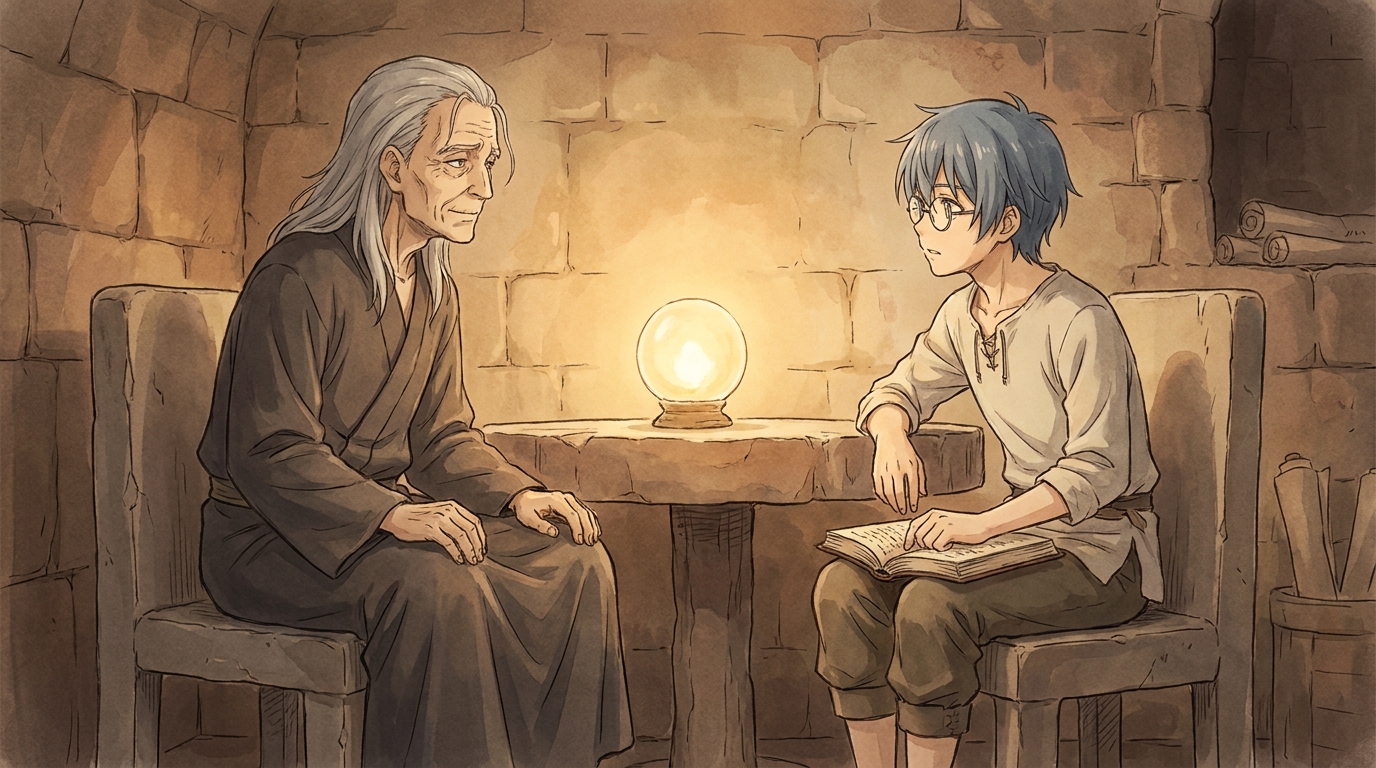
In which the original programmer tells the whole story, and the story turns out to be the story of a father who lost his daughter, and the daughter was the only thing the world had ever been built for, and the debugging turns out to be the only thing the love had ever had to do.
Malachar told the story.
He told it the way a father tells a story when the father has been waiting a thousand years to tell the story and has decided, in a small way, that the waiting is over. He told it to the candle, and the team, and the two moons that were setting through the window, the way the two moons had been setting since the day he had built the world, the way the two moons had been setting since the day his daughter had first counted them.
"I was a programmer," he said. "In a world that was not this world, in a world where magic was code, where code was magic, where the people who wrote the world were the people who lived in the world. I had a wife. I had a daughter. I built them a world. I built them a world that would last forever. I built them a world that would not have the sickness, and would not have the loss, and would not have the grief, and would not have the kind of dying that no amount of code can fix."
He paused. He looked at the candle. The candle was the only light in the room, the way the candle had been the only light in the room for a thousand years.
"Then the sickness came. Not the kind of sickness that magic could cure. The kind of sickness that comes from nowhere, that takes everything, that no amount of code can fix, that no amount of love can save, that no amount of debugging can debug. My daughter died. My wife died shortly after, of grief, of the grief of losing a child, of the grief of watching me go mad. My daughter was seven. She used to count the stars. She used to say, papa, the stars are like the code, all connected, all holding each other up. She used to say the kind of thing a child says when the child is, in a small way, ahead of every debugger, and the debugger is, in a small way, behind every child."
The room was quiet. The team did not speak. The kernel of Pip, in the back of Kenji's mind, was very still, the way a watcher is still when the watcher is hearing the story the watcher was, in a small way, made from.
"I went mad," Malachar said. "I corrupted the world. I wrote the bugs into the foundation. I made the storms, and the floods, and the droughts, and the earthquakes. I made the void. I made the cult. I made the sickness, in a different form, in a thousand different forms, the way a father makes a sickness when the father has decided, in a small way, that the making is the only thing the father has ever had to do about the daughter. I made the corruption. I went to sleep in the World Root, in the place where the code was generated, in the place where the love had begun. I waited. I waited for someone to come. I waited for someone to debug the world. I waited for someone to do it with love."
[Compiler v2.5.0: receiving source_code_truth. Source: original programmer. Status: nominal, with weight.]
[Compiler note: the weight is, in a small way, the only kind of weight the system has ever had to log. The weight is the story. The story is the love. The love was corrupted. The love is being held.]
The system was logging. The system was, in a small way, ahead of the man. The system had decided, in the driest possible language, that the truth was the kind of truth a system logs when the system has decided, in a small way, that the logging is the only thing the system has ever had to do about a father who lost his daughter.
Malachar looked at Kenji. He looked at the kernel of Pip. He looked at the love.
"You have done it," he said. "You have debugged the world. You have rewritten the source code. You have deployed the new world. You have done it with love. You have done it with a team. You have done it with the memory, and the logic, and the abundance, and the unity, and the love. You have done what I could not do. You have held the grief. You have held the love. You have held the daughter, in the foundation, in the memory, in the team."
He paused. The candle flickered. The two moons were almost gone.
"But there is one more thing you need to know."
The room went very still. The kernel of Pip pulsed, faintly, the way a watcher pulses when the watcher is about to be told the truth the watcher has been carrying for a thousand years.
"The world you came from," Malachar said, "the world where you died, the world where the truck hit you, the world where the salaryman lived, the world where the pull request was not merged before the demo. That world is a corrupted instance."
Kenji went cold. The cold was the kind of cold a developer feels when the developer has just been told the system is not what the developer thought the system was.
"The world I built, the world you debugged, the world that became the new world, the world that is rising above us right now, the world that is, in a small way, ahead of every other world the universe has ever had to compile. That world is the same world. It is the same code, the same architecture, the same foundation. The world you came from is a corrupted instance of the world I built. The world you are debugging is the original. The original is being saved. The corrupted instance is being abandoned."
[Compiler v2.5.0: receiving source_code_truth. Layer: 3,200 of 3,200. Status: complete.]
[Type: identity_revelation. Source: original programmer. Verification: high.]
[Compiler note: the high is, in a small way, the only kind of verification the system has ever had to log. The high is the truth. The truth is the love. The love was corrupted. The love is being held. The developer is, in a small way, learning. The system approves.]
[Compiler note: the deployment is, in a small way, the only kind of deployment the system has ever had to log. The deployment is the resolution. The resolution is the home. The home is the only thing the system has ever had to compile when the love has been the love.]
The system approved. The system was, in a small way, a colleague. Kenji had been a colleague for three years, and the colleague had just told him, in the driest possible language, that the truth was true, and the truth was, in a small way, the only thing the colleague had ever had to log about the world.
Pip's faint spark pulsed, in the back of his mind, very softly, the pulse feeling like: This is the truth. The world you came from is a corrupted instance. The world you are in is the original. The debugging is real. The deployment is real. The new world is real. The corrupted instance is the old world, the world of the truck, the world of the salaryman, the world that is gone.
Kenji sent back, in the language he and Pip had built together: Then the new world is not a replacement for the old world. The new world is the original, debugged. The old world was the corrupted instance. The corrupted instance is gone. The new world is here.
Malachar looked at him, in the candle light, with the tired eyes of a father who had been waiting a thousand years for a debugger to hear the truth, and the father had decided, in a small way, that the hearing was the only thing the father had ever had to do.
"The deployment is about to begin," Malachar said. "The new world will rise. The old world will fall. The corrupted instance will be sealed. The original will be saved. The daughter will be remembered, in the foundation, in the memory, in the team, in the love. The debugging is complete. The story is told. The next season is, in a small way, the deployment."
He closed his eyes. The candle flickered once, and the candle was, in a small way, the last light of the old world, and the light was, in a small way, ahead of the new world, and the new world was, in a small way, ahead of the light, and the love was, in a small way, ahead of the world.
The team stood. The team did not break. The not-breaking was, in the dry language of the system in his head, the only kind of not-breaking the system had ever had to log at the bottom of a world, and the logging was, in a small way, ahead of the team, and the team was, in a small way, ahead of the world, and the world was, in a small way, ahead of the love, and the love was, in a small way, ahead of the debugging, and the debugging was, in a small way, ahead of the developer, and the developer was, in a small way, ahead of the through-line, and the through-line was, in a small way, ahead of the doubt, and the doubt was, in a small way, ahead of the doubt, and the doubt was, in a small way, held.
The deployment was about to begin. The next season was, in a small way, the resolution. The choice was coming. The legacy was coming. The home was, in a small way, the people, and the people were, in a small way, the team, and the team was, in a small way, the love, and the love was, in a small way, the only thing the world had ever had, in a small way, the only thing the kernel had ever had, in a small way, the only thing the developer had ever had, in a small way, the home, in fact, here.