The Proxy Wars
In which our protagonist discovers that the cult has been playing a longer game, and General Rourke becomes a problem.
The crystals went dark on a Tuesday, and the dark was, in a small way, the kind of dark that the system had been quietly hoping would not be the kind of dark that the system was about to be remembering for the rest of the season.
Three of the southern crystals, in three of the southern kingdoms, all part of the alliance, all signed to the Council of Kings' charter, all working with the crystal network, all running the climate thermostat, all part of the debugging partnership that the developer had spent two seasons building, simply went dark. One at noon. One at two. One at four. The pattern was not random. The pattern was, in the dry language of the system in his head, the pattern of a coordinated disconnection, and the coordinated disconnection was, in a small way, the kind of thing that a senior engineer sees once in a career and wishes they had never seen.
[Compiler note: three nodes offline. Pattern: coordinated. Time-to-coordination: 4 hours.]
[Compiler note: this is not a network failure. The system is, in a small way, certain.]
[Compiler note: the developer is, in a small way, advised to wake Elara.]
He woke Elara. Elara was, in the driest possible language, the kind of captain who slept with her sword within arm's reach and her notebook on her chest, and the notebook was, in a small way, the kind of notebook that had been quietly logging the southern reports for two seasons, and the logging was, in the driest possible language, the kind of logging that was about to be the most important logging the notebook had ever done.
She read the reports. She looked at the map. She said, in the flat voice that meant she was angry: "The cult has been playing a longer game than we knew. The cult has been embedding agents in the southern kingdoms for decades. The cult has been, in a small way, the patient kind of bug that waits for the system to be confident before it strikes."
"How long?" Kenji asked.
"Longer than you have been in this world. Longer than I have been captain. The cult was here before us. The cult will be here after us, if we do not debug it."
The Council of Kings convened before the sun hit the western wall. General Rourke, the military man from the eastern kingdom, the man who had been skeptical of the magic-based alliance from the start, was already in the audience chamber. He was wearing his parade uniform. The uniform was, in a small way, the kind of uniform that says "I have been waiting for this moment, and the moment is, in the driest possible language, the moment I have been preparing my entire career for."
"The alliance is broken," Rourke said, in a voice that was carrying to every corner of the chamber. "The Strange Sage cannot debug the world. The Strange Sage can only debug towns. The kingdoms must return to the old ways. Strong armies. Strong borders. Strong kings."
The message went out over the eastern kingdom's crystal network before Kenji could respond. The message was propaganda. The message was, in the driest possible language, the kind of message that a senior engineer sees once in a career and wishes they had never seen, because the message was, in a small way, the message that was going to be remembered as the moment the alliance almost split.
[Compiler note: the system is, in a small way, the senior engineer who has been asked to debug a political crisis.]
[Compiler note: the developer is, in a small way, ahead of the developer. The system approves.]
"We need to respond," Elara said. "We need to show strength. We need to take back the south."
"We need to debug the south," Kenji said. "We do not take it back. We do not invade. We do not send armies. We send debuggers."
"Debuggers do not win wars."
"Debuggers do not need to win wars. Debuggers win the system. We send debuggers, and the system wins itself. The winning is, in a small way, the through-line, restated at the level of armies."
The Council argued. Rourke was already mobilizing. The southern kingdoms were still dark. The alliance was on the verge of splitting, and the splitting was, in a small way, the kind of splitting that the system was, in a small way, going to be logging as the worst bug the system had ever seen.
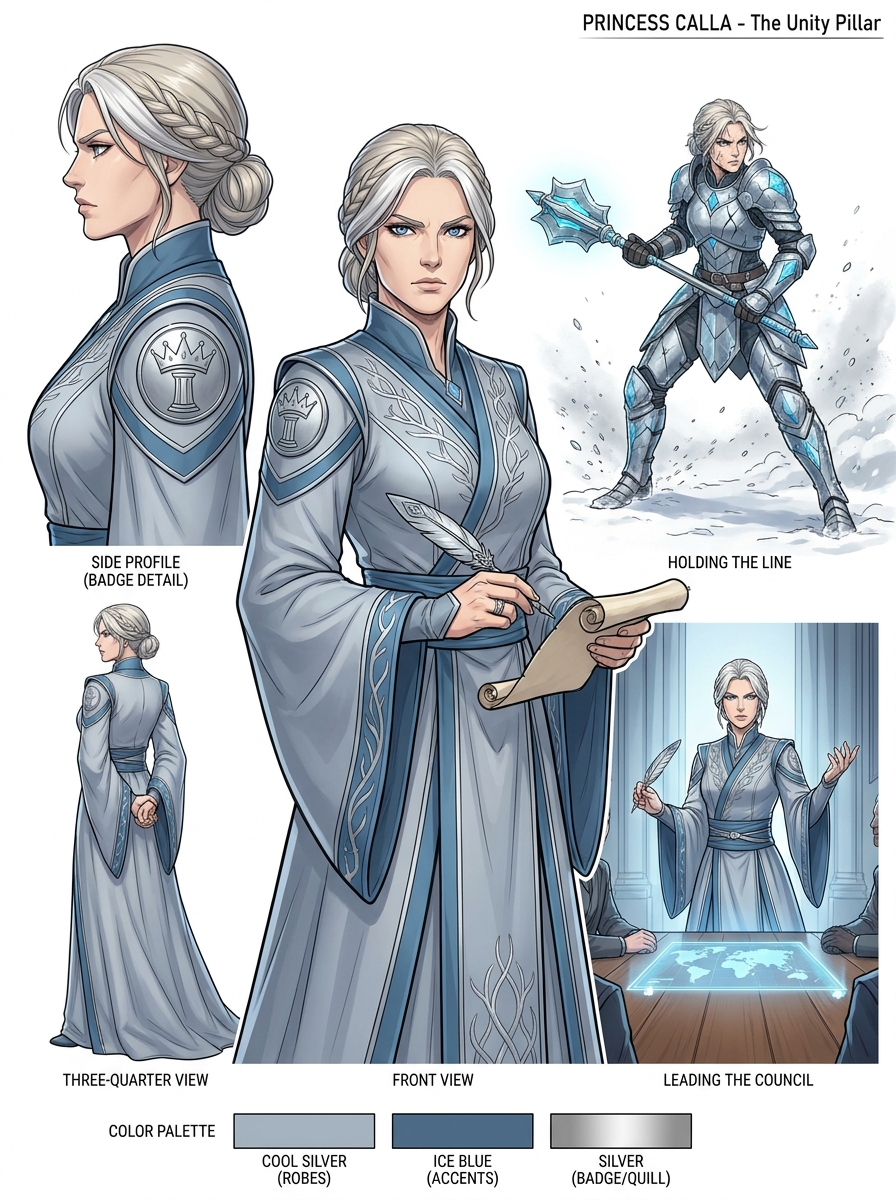
Then Calla stood up.
The room went quiet. The princess of the northern kingdom did not stand up often. When she stood up, the kingdoms listened. The standing was, in a small way, the standing of a person who has decided, and whose decision is good.
"The northern kingdom will fight," she said. "Not for the alliance. For the team. We will not debug the south. We will fight for it. We will defend the alliance. We will defend the debugging. We will defend the man who debugs the world."
The room was quiet.
"I have a kingdom," Calla continued. "I have an army. I have a princess's authority. I am going to use them. I am going to take the northern army south. I am going to hold the line until the debuggers arrive. The holding is, in a small way, the love, and the love is, in a small way, the wall, and the wall is, in a small way, the job."
She looked at Kenji. "I am going to do this because I am on the team. I am going to do this because the team is worth fighting for. The fighting is, in the driest possible language, the kind of fighting that the team was, in a small way, always going to be remembering."
Kenji looked at her. He thought about the through-line. He thought about the fact that "any sufficiently well-defined problem is solvable" was true, but it was also true that some problems needed to be fought, not debugged. Some problems were about the system. Some problems were about the people. Calla was offering to fight the people problem, and the offering was, in a small way, the kind of offering that the system was, in a small way, going to be logging as the moment the alliance stopped being a treaty and started being a family.
"Okay," he said. "We do both. We fight, and we debug. We hold the line in the south. We debug the corruption in the capitals. We do not let the alliance split. We do not let Rourke win. We do not let the cult win. The cult is, in a small way, the patient kind of bug, and the patience is, in a small way, the kind of patience the system has been waiting to outwait."
[Compiler note: the plan is, in a small way, the largest coordinated deployment the system has ever processed.]
[Compiler note: the system is, in a small way, proud. The system is, in a small way, the senior engineer who has been asked to onboard a junior developer's first war.]
[Compiler note: the developer is, in a small way, learning what team means.]
The plan was made. Calla took the northern army south. Elara coordinated the militaries. Seraphina redirected the trade routes to support the war effort, with the specific efficiency of a person who has been quietly funding this exact scenario for six months. Lian designed a spell to detect cult agents in the southern kingdoms, the spell that was, in a small way, the kind of spell that was going to be remembered as the moment the apprentice outgrew the mentor. Kenji worked the crystal network, talking to every king, every queen, every general, every mage, explaining the debugging, the alliance, the through-line, in the driest possible language, with the patience of a person who has been quietly logging this conversation in his head for two seasons.
The Battle of Three Armies was coming. The battle was, in a small way, the kind of battle that the system was, in a small way, going to be logging as the moment the alliance decided, in fact, to be an alliance, and the deciding was, in a small way, the work.