The Battle of Three Armies
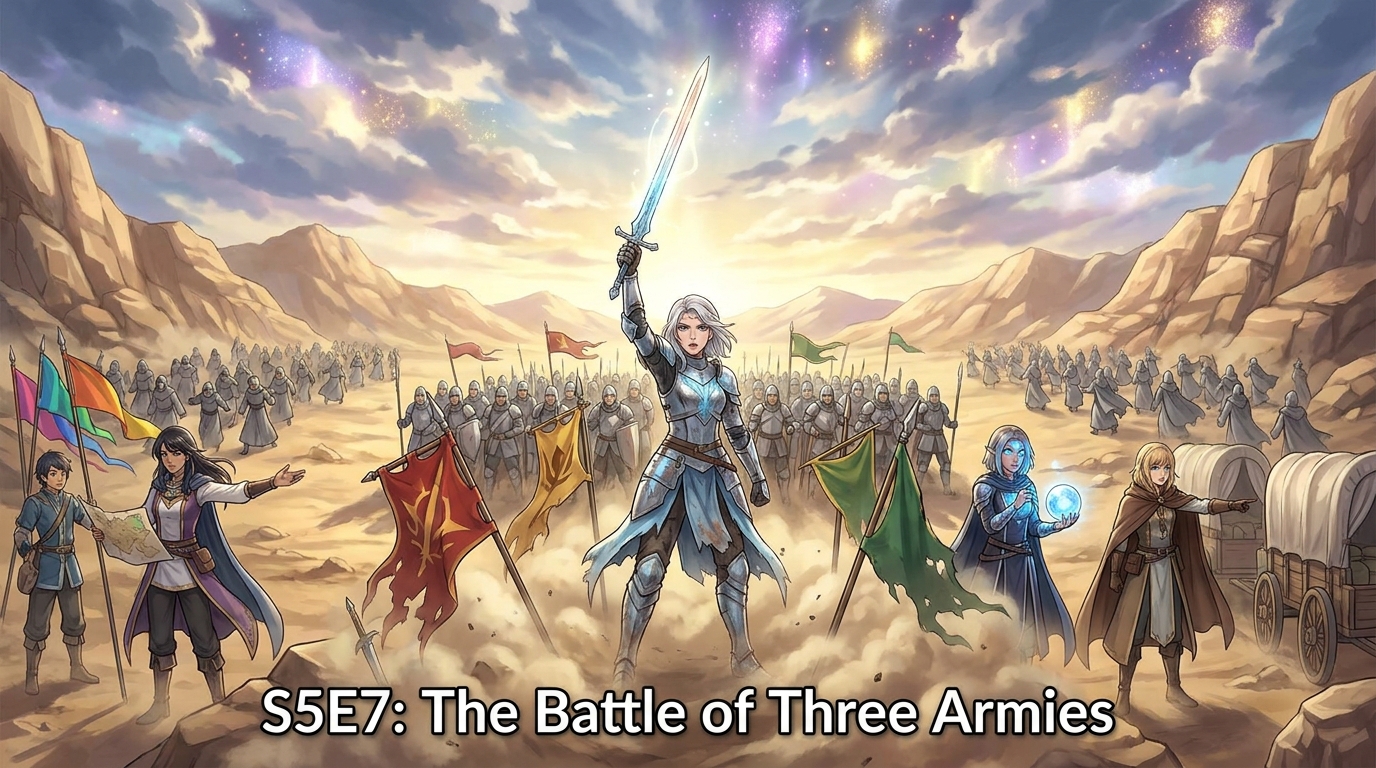
In which our protagonist coordinates a multi-front defense, and discovers that the battle was always going to be won by the team.
The Battle of Three Armies happened in a valley in the southern kingdoms, on a cold morning in late winter.
There were three armies. The first was the cult's army, which had been gathering in the south for months, growing in numbers, growing in confidence, growing in the certainty that Malachar was about to win. They were a mix of true believers, mercenaries, and the corrupted southern kingdoms' own soldiers, who had been turned by the cult's decades of patient work. They were forty thousand strong.
The second army was General Rourke's eastern force. He had not joined the cult. He had joined the chaos. He had decided that the alliance was weak, that the debugging was a failure, that the old ways were the right ways. He had brought thirty thousand men, well-trained, well-equipped, ready to take the alliance apart from within.
The third army was Calla's northern force. She had brought twenty thousand men, well-trained, well-led, with the princess's authority and the alliance's crystal network. They were the underdogs. They were also the only army that was on the right side.
Kenji was not at the battle. He was in the capital, in the audience chamber, with Elara and Lian and the king, coordinating the multi-front defense through the crystal network. The defense was not just the battle. The defense was the debugging of the southern kingdoms' capitals, the detection of the cult agents, the restoration of the crystal network, the re-integration of the southern kingdoms into the alliance.
The defense was, in the language of his old job, a coordinated deployment. Three fronts. Three teams. Three problems. All running in parallel, all coordinated through the same network, all designed to debug the system at the same time.
Calla held the line in the south. She was not a general. She was a princess. But she had been trained by Elara, advised by Seraphina, supported by the crystal network, and she had the kind of authority that comes from being right. She held the line. She did not advance. She did not retreat. She held.
Lian detected the cult agents. The spell she had designed, the cult detection spell, was running in every southern kingdom's capital, scanning every official, every guard, every bureaucrat. The agents were marked. The marked agents were quietly arrested. The crystal networks were restored. The southern kingdoms began to remember that they were part of the alliance.
Elara coordinated the militaries. The raid plan, the firewall formation, the coordinated defense, all of it was being run from the capital, with the crystal network carrying the orders, with the generals in the field receiving them in real time. The alliance was not just fighting. The alliance was debugging while fighting.
Kenji worked the kings. He called every king, every queen, every general, every leader. He told them the truth. He told them about Malachar. He told them about the corruption. He told them about the void. He told them about the source code. He told them about the through-line. He told them that the alliance was not weak. The alliance was the only thing that had ever worked.
On the third day of the battle, General Rourke's eastern force broke. They had been fighting the cult, not the alliance, because the cult had been the one who had convinced them to attack. When the truth came out, when the crystal network broadcasted the evidence, when the alliance's debuggers showed the propaganda for what it was, Rourke's own men turned on him. He was arrested by his own lieutenants, tried by his own court-martial, sentenced to exile.
The cult's army broke next. Without Rourke's support, without the propaganda, without the hope of internal collapse, they were just forty thousand fanatics facing an alliance of seven kingdoms. They ran. The alliance did not pursue. The alliance let them run. The debugging was about integration, not destruction.
Calla held the line. She did not advance. She did not retreat. She held, for three days, with twenty thousand men against forty thousand cultists, and she did not break.
When the cult's army broke, Calla's northern force did not cheer. They stood down. They saluted. They had done their job.
Kenji watched the whole thing from the capital, with Elara at his side and Pip's faint spark in the back of his mind, and he thought: "We did it. We debugged a war. We held the line and we debugged the system and we won both."
The after-action report was clear. The southern kingdoms were restored. The cult's network in the south was broken. General Rourke was exiled. The alliance was not just intact. The alliance was stronger.
The Battle of Three Armies was the moment when the alliance stopped being a treaty and started being a fact.
# WORLD.md (updated)

## Status
- Battle of Three Armies: won by the alliance
- General Rourke: arrested, exiled
- Calla: held the line, three days, twenty thousand vs forty thousand
- Cult's southern network: broken
- The alliance: stronger, no longer a treaty, now a fact

## Lessons
- A battle is a system. A system can be debugged.
- The alliance was not weak. The alliance was the only thing that had ever worked.
- A princess who holds the line for three days is a princess worth marrying
- The debugging and the fighting can happen at the same time