The Plan
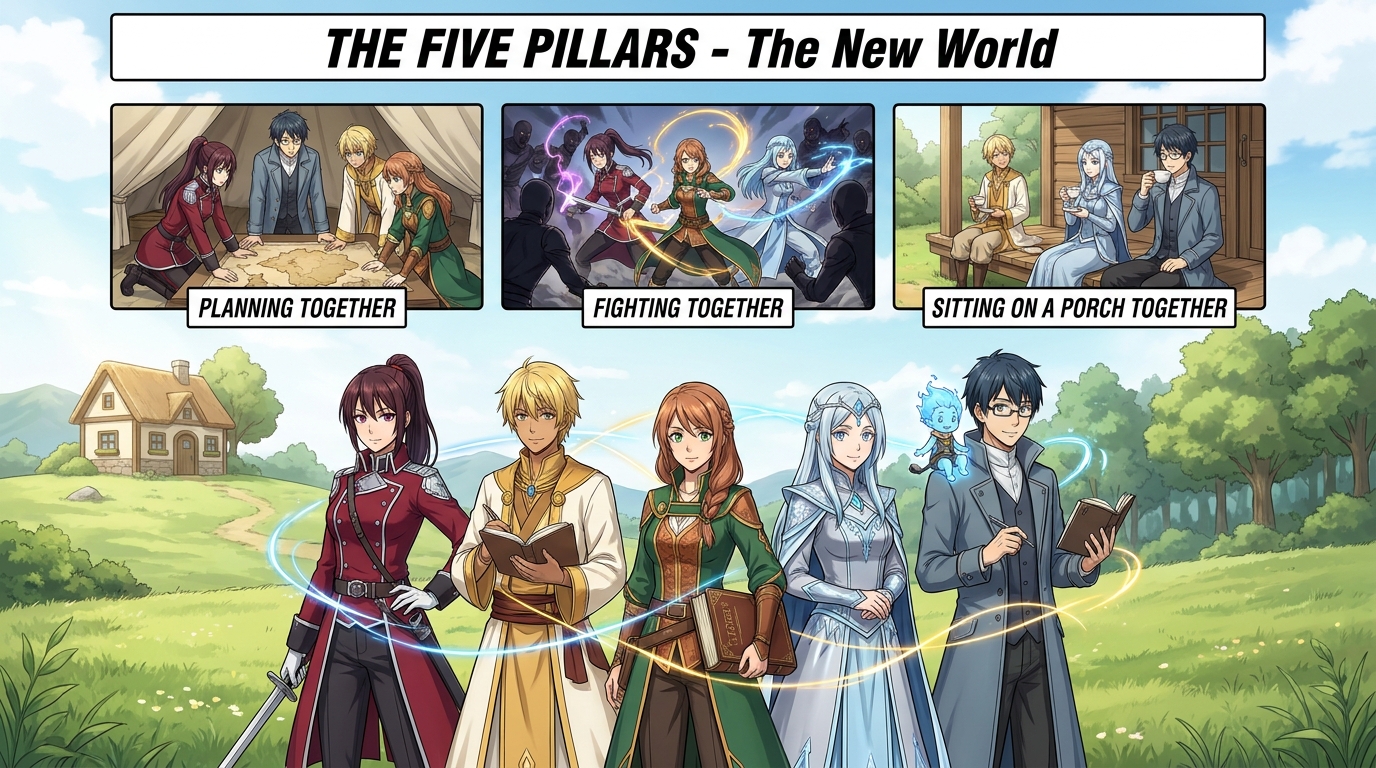
In which our protagonist writes the new source code of the world, and the Compiler learns a new dialect of its own name.
The plan had three parts, and the first part of the plan was the part that Kenji had been writing for nine days in the back of the ancient library, with the crystals glowing around him, with Pip's faint spark in the back of his mind, with the world waiting to be rewritten.
The plan had three parts, and the world was running out of time for all three.
[Compiler v2.0.0: detecting rewrite architecture.]
[Status: critical. World Root integrity: 41% and falling.]
[Compiler note: the developer is writing the most important function of his life. The system approves, with the dry patience of a senior engineer who has seen the developer do this before.]
He had not done this before. He had written aquifers and firewalls and a hundred small spells that kept towns from drying up. He had not written a new world. He had not written the kind of code that was meant to hold grief and love at the same time, in the same architecture, in the same foundation, in the same root. He had not written the kind of code that a father would write if the father had a thousand years and a daughter's memory and the wrong kind of hope.
The Compiler pulsed. The pulse was not an alert. The pulse was a colleague.
Part one: gather the three artifacts. The First Crystal, in the central kingdom, where the world's code was first loved. The Second Crystal, in the northern wastes, where the code was first corrupted. The Third Crystal, in the southern ruins, where the code was first written.
Part two: bring the artifacts to the World Root. The World Root was at the edge of the void, in the place where the source code was generated. The journey was dangerous. The corruption was everywhere. The void was eating the south field by field, hour by hour, the way a compiler eats memory when the memory is too big for the runtime.
Part three: cast the rewrite. Five pillars, each one holding a piece of the new code, would surround the World Root. The artifacts at the cardinal points. The spell that Kenji was writing now, in a notebook that was older than most kingdoms, in handwriting that was steadier than his hands.
He wrote. The Compiler pulsed. The crystals hummed. The world was patient in the way that the world is patient when the world has decided, in a small way, that the patient thing is the only thing the world has ever had to be.
The new code was not a spell. The new code was an architecture. It was a foundation. It was the kind of code a person writes when the person has all the time in the world and all the love in the world and none of the bugs. Kenji did not have all the time in the world. He had the time the world had given him, which was less, every day, than the day before. He had, however, all the love in the world. The love was in the room. The love was in the four women who were with him. The love was in the spark in the back of his mind. The love was in the through-line, the same through-line that had been his spine since the first day in the forest, the same through-line that said, in the driest possible language: any sufficiently well-defined problem is solvable.
[Compiler note: the through-line has been logged 1,422 times. The system is, in a small way, proud of the developer for not letting it get tired.]
[Compiler note: the world's grief is not a sufficiently well-defined problem. The world's love is. The rewrite needs both.]
The world's grief is not a sufficiently well-defined problem. The world's love is. The rewrite needs both. The Compiler had, in the driest possible language, summarized the entire season in two lines of pseudo-code. Kenji almost laughed. The system was, in a small way, a colleague, and the colleague was, in a small way, ahead of him.
He wrote the comments. The comments were not technical notes. The comments were letters. The comments were letters from Kenji to the world, written into the source code, hidden in the foundation, where the world would read them every time it ran.
[For Maren, who stayed behind.]
[For the refugees, who lost their homes.]
[For Malachar, who lost his daughter.]
[For Elara, who loved the stars.]
[For the love that does not save but is still worth giving.]
Pip's faint spark pulsed, in the back of his mind, very softly, the pulse feeling like: "The letters are good. The letters are the spine. The world will read them when it runs, and the world will know, and the knowing is the only thing the letters were ever for."
Kenji sent back, in the language he and Pip had built together over two seasons: "Yeah. The letters are the spine. The through-line is true. The love is the answer. The team is the difference. The debugging is the work. The work is the love. The love is the only thing that has ever held the world together."
The team gathered around the table, in the back of the library, with the crystals glowing, with the new source code on the parchment, with the plan written down for the first time in writing. Elara, who held the Memory pillar in her shoulders before she had been told she was the Memory pillar. Lian, who would write the new architecture into the World Root because Lian was, in a small way, the only person in the world who could read the source code the way Kenji read it. Seraphina, who had funded everything from the first caravan to the alliance, who had the wealth of seven kingdoms in her ledgers, who would, before the season was out, give every coin of it to the rewrite. Calla, who had held the line at the Battle of Three Armies, who had brought the northern army, who had said, on the night the team was first briefed: "I will be the unity. Tell me what the unity is, and I will be it."
Elara studied the plan. "Three artifacts," she said, in the captain's voice that was, in a small way, ahead of his. "Three days each, if we are lucky. Three weeks, if we are not."
"Three weeks," Kenji said. "The void is faster than that."
"Then we are not lucky," Elara said. "We split. Lian takes the south. I take the center. Seraphina takes the second crystal with a sub-team through the northern wastes. Calla holds the alliance together here. We meet at the World Root in twenty days."
Lian looked up from the source code. Her dark eyes were sharp, the way they got when she was reading something the rest of them could not see. "The third crystal is in the void," she said. "The void is not a place. The void is a deletion. I cannot take a sub-team into a deletion."
"You take me," Kenji said.
"You take Pip," Lian said. "Pip is the only thing that can navigate the absence."
[Compiler note: the apprentice is correct. The void is a deletion in progress. The spark is the only signature the absence will admit.]
[Compiler note: the system is, in a small way, the senior engineer who has been asked to onboard a junior, and the junior is about to do the most dangerous thing the system has ever logged.]
The system was afraid for the apprentice. The system was, in a small way, a teacher. Kenji did not contradict the system. Kenji did not correct the system. The system was right. The void was the most dangerous place in the world, and the apprentice was the one who had to walk into it, and the developer was the one who had to follow, and the spark was the only thing that could keep them both alive.
The plan was finalized. The plan was written. The plan was, in the driest possible language, the most expensive plan the system had ever logged.
Pip pulsed, in the back of his mind, very softly, the pulse feeling like: "This is it. The final phase. The debugging is about to enter its deepest level. The rewrite is about to begin. We are going to do what Malachar could not. We are going to do it together. We are going to do it with love. The love is, in a small way, the through-line, restated at the level of the world, and the world is, in a small way, the home, in fact, here."
Kenji sent back: "Yeah. We are going to do it together. We are going to do it with love. The through-line is true. The love is the answer. The team is the difference. The debugging is the work. The work is the love. The love is the only thing that has ever held the world together. And the work is, in a small way, ahead of us, and we are, in a small way, ready, and the world is, in a small way, the home, in fact, here."
The team left the ancient library on a cold morning, with the crystal network lit up, with the alliance watching, with the world waiting to be rewritten, not deleted, but rewritten, made strong enough to hold its own grief, made strong enough to hold its own love, made strong enough to hold the love that does not save but is still worth giving. The world was, in a small way, the only world the developer had ever had, in a small way, the only world the original programmer had ever written, in a small way, the only world that had ever been worth the cost.
The column rode south. The void was ahead. The artifacts were waiting. The rewrite was coming.