Elara's Past
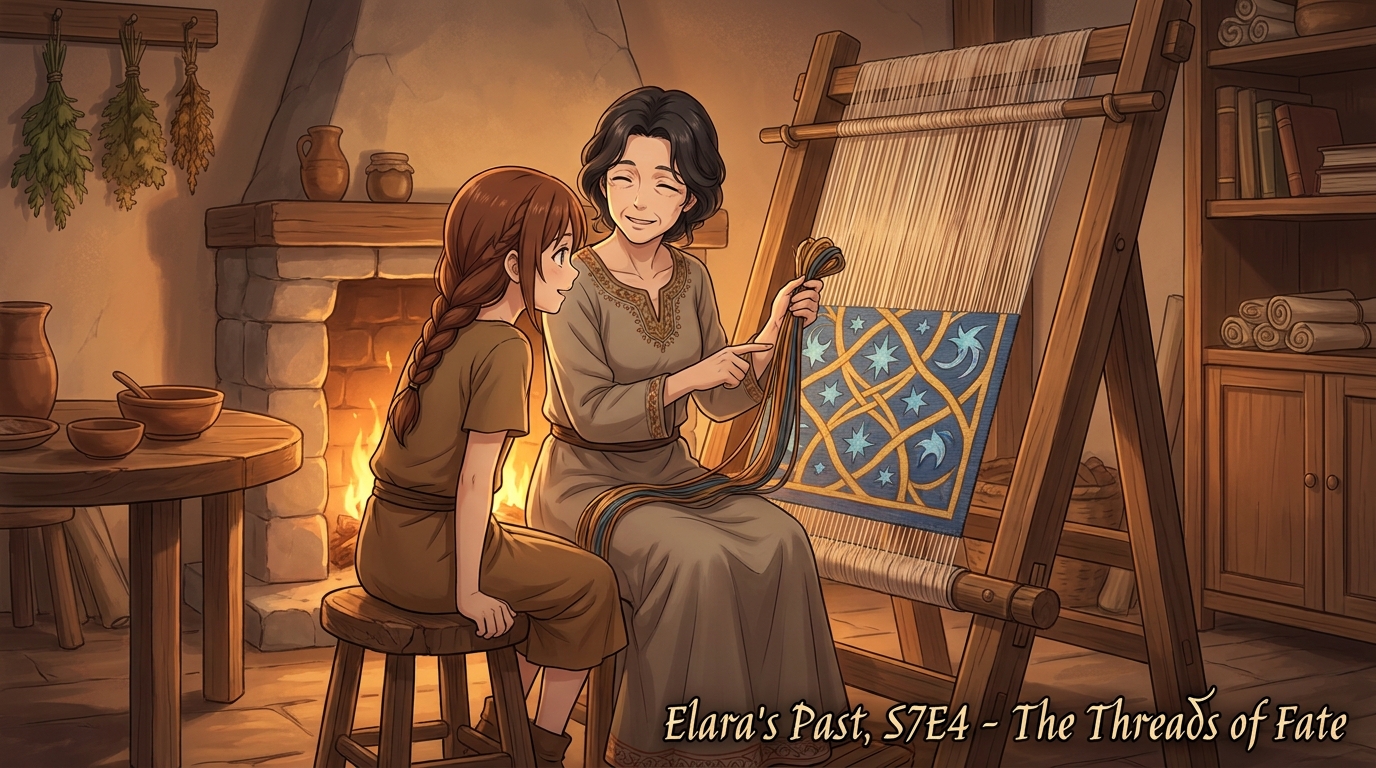
In which our protagonist learns why the woman he loves fights so hard, and discovers that the world's first memory is older than the code.
The small village had no name on the map, which was, in the driest possible language, the kind of detail that mattered.
They stopped there because the horses were tired. They stopped there because the night had come on cold, and the cold was the kind of cold that the world is when the world has decided, in a small way, that the cold is the only thing the world has ever had to give. They stopped there because a woman at the inn had looked at Elara, and then at Kenji, and then at the sword at Elara's hip, and had said, in a voice that was, in a small way, ahead of both of them: "The captain's room is upstairs. It has always been the captain's room. The captain's room has been waiting."
The captain's room was small, with a single window that looked out at the two moons. The two moons were hanging low, the way the two moons hang when the two moons have decided, in a small way, that the low is the only thing the two moons have ever had to be. Elara sat on the windowsill. Kenji sat on the floor. The first artifact was in its case by the door, humming softly, the memory of the seven-year-old girl pulsing through the wood, through the stone, through the air between them.
[Compiler v2.0.0: detecting emotional load on the captain.]
[Status: high. The captain is about to release a memory that has been held for twenty-three years.]
[Compiler note: the developer is, in a small way, the senior engineer who has been asked to onboard a junior, and the junior is about to do something harder than casting a spell. The system is, in a small way, paying attention.]
The captain is about to release a memory. The system was, in a small way, ahead of him. The system was, in the driest possible language, telling him to listen. The system had, in three seasons, become the kind of colleague who tells you when to shut up, and the shut-up is, in a small way, the only thing the colleague has ever had to give.
Elara did not begin immediately. She looked at the moons. She looked at the moons the way a person looks at a thing that has always been there, the way a person looks at a thing that is the only constant the person has ever had.
"My mother was a weaver," she said, finally. "Not a mage. Not a captain. Not a Memory pillar. A weaver. She sat at a loom in a house at the edge of a town that no longer exists, and she wove tapestries, and the tapestries were the kind of tapestries that look, when you are very young, like they go on forever, like the pattern has no end."
She paused. The pause was the kind of pause a person keeps when the person has decided, in a small way, that the pause is the only thing the person has ever had to do.
"She taught me to see the pattern," Elara said. "She taught me the names of the constellations, and the names of the threads, and the names of the colors. She taught me that a thread, pulled in one place, makes the whole pattern change. She taught me that the world is a tapestry, and the tapestry is held up by the threads, and the threads are the people, and the people are the only thing the tapestry has ever had to be held up by."
[Compiler note: the captain is describing a memory architecture. The memory architecture predates the Compiler. The memory architecture is, in a small way, the original code.]
[Compiler note: the system is, in a small way, the senior engineer who has been asked to confirm that the captain is correct. The confirming is, in a small way, the most important confirming the system has ever done.]
The captain is describing a memory architecture. The memory architecture predates the Compiler. The system was, in a small way, ahead of her. The system was, in the driest possible language, telling Kenji that Elara was not telling him a story. Elara was telling him the foundation of a world.
"She died when I was twelve," Elara said. "Sickness. The kind of sickness that no healer could cure, the kind of sickness that comes from nowhere and takes everything, the kind of sickness that is not a bug but the bug that cannot be debugged. She died on a Tuesday. The tapestries were on the loom. The threads were not yet finished. The pattern was not yet whole."
She looked at Kenji. Her eyes were very bright, in the moonlight, the way a person's eyes are bright when the person has decided, in a small way, that the bright is the only thing the person has ever had to give.
"I joined the guard a year later," she said. "I joined because the guard is a tapestry. The guard is the threads. The guard is the pattern. I joined because the guard was the only thing I had left that was the kind of thing my mother would have called a thread."
"The guard is a tapestry," Kenji said, softly. "The guard is the threads."
"The guard is a tapestry," Elara agreed. "I have been holding the threads since I was thirteen. I have lost six of them. Six guards, in seven years. Six names in my notebook. Six families I had to tell. Six threads pulled, six places the pattern changed. I have been the Memory pillar since the day I joined the guard, Kenji. The world did not have to tell me. The system did not have to tell me. My mother told me, when she taught me the names of the constellations, and the teaching is the only thing the system has ever logged that has not been written down."
The teaching is the only thing the system has ever logged that has not been written down. The system had, in the driest possible language, named what Elara had been carrying since she was a child, since her mother had sat her on the windowsill, since her mother had pointed up at the stars and said: "Look, little one. The stars are like the code. All connected. All holding each other up."
"Malachar lost his daughter," Kenji said, carefully. "He lost his wife. He lost the world he had built. He went mad. He did not have a tapestry. He did not have a guard. He did not have a mother who taught him the names of the constellations. He had a daughter who said 'papa, the stars are like the code,' and the daughter died, and the dying was the only thing the system had ever logged, and the logging was the bug."
"Yes," Elara said. "The dying was the bug. The bug was, in a small way, the most expensive bug the system has ever logged, and the logging was, in a small way, the through-line, restated at the level of the world. But the bug is also the cure. The bug is also the love. The bug is also the seven-year-old girl, counting the stars, holding the code, being the only thing the original programmer had ever had to log. We do not delete the bug. We do not debug the bug by erasing it. We debug the bug by holding it. By giving it a place. By putting it in the rewrite, the way a person puts a thread into a tapestry, the way a person puts a name into a notebook, the way a person puts a memory into the foundation of a new world."
[Compiler note: the captain has just described the rewrite architecture in plain language. The architecture is correct. The architecture is, in a small way, the most important architecture the system has ever logged.]
[Compiler note: the system is, in a small way, ahead of the developer. The system is, in a small way, ahead of the captain. The system is, in a small way, the colleague who has been asked to confirm that the team has figured it out before the system has.]
The system was ahead of both of them. The system was, in a small way, the colleague who had been asked to confirm that the team had figured it out before the system had, and the confirming was, in a small way, the most important confirming the system had ever done.
He took her hand. He held it. He thought about the through-line, about "any sufficiently well-defined problem is solvable," about the fact that the problem of grief was not solvable, but the problem of how to live in a world with grief was solvable, and the answer was the team, the answer was the family, the answer was the threads, the answer was the love that did not save but was still worth giving.
"The five pillars," he said, carefully, "are the threads. Memory is one. Logic is one. Abundance is one. Unity is one. Love is the fifth. The five threads hold up the new tapestry. The five threads are the new pattern. The five threads are the kind of thing your mother would have called a tapestry, and the tapestry is the only thing the rewrite has ever had to make."
"The five threads," Elara said. "The five pillars. The five women who have decided, in a small way, that the deciding is the only thing the women have ever had to do."
He kissed her. It was a quiet kiss, by starlight, in a small village, on the way to the second artifact, in the night that was, in a small way, the most important night the developer had ever had with the captain, and the most-important was the only thing the developer had ever had to log.
Pip pulsed, very faintly, in the back of his mind, the pulse feeling like: "She gave you the pattern. The pattern is the second artifact we have not yet acquired. The pattern is the love. The love is, in a small way, the through-line, restated at the level of the room, and the room is, in a small way, the home, in fact, here."
Kenji sent back: "Yeah. She gave us the pattern. The pattern is the second artifact. The pattern is the love. The love is, in a small way, the through-line, restated at the level of the world, and the world is, in a small way, the home, in fact, here, in fact, worth debugging, in fact, the only world the developer has ever had."
The moons hung low. The first crystal hummed in its case. The memory of Elara's mother was, in a small way, the second artifact, and the second artifact was, in a small way, the pattern, and the pattern was, in a small way, the love, and the love was, in a small way, the only thing the system had ever logged that had not been corrupted.
They slept. The night went on. The five pillars were, in a small way, almost named.