The Choice
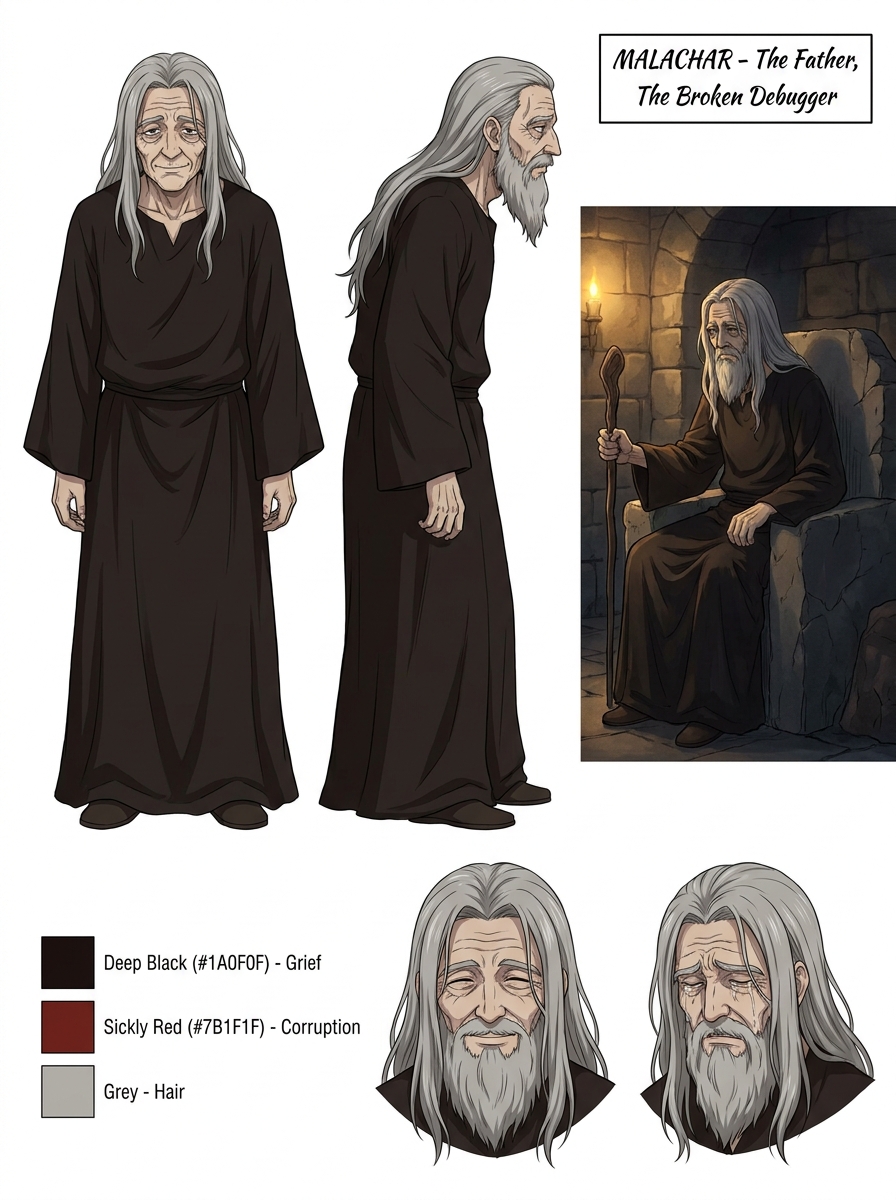
In which our protagonist faces the final choice, and discovers that the choice is not between two options, but between three.
The choice was on the table, and the choice was not what anyone had expected, and the choice had been waiting for him since the night the fourth goblin had told him, in a voice the Compiler had not translated, that the system was his.
Kenji stood in the inner sanctum with the team, with Malachar sitting in his chair, with the new world pulsing around them in the way a debugger's screen pulses at 3 AM when the build is half-green and half-red and the only thing left is the deploy button. The cult's corruption was gone. The void was gone. The storms were gone. The droughts were gone. The five pillars were in their positions, each holding a piece of the rewrite. The work was done, except for the one decision the team could not make without him.
[Final configuration: PENDING. Decision required: target=Malachar]
[Options registered: 3. Default: null.]
[Compiler note: the developer is, in a small way, the only one who can choose.]
The system had opinions. The system had, in nine seasons, developed a tone that Kenji had come to think of as the senior engineer who has been asked to onboard a junior, and the senior engineer had just logged, in the driest possible language, that the configuration was pending the developer's call.
Elara spoke first. Her voice was the voice of a captain who had been asked, in front of her guard, what the order of the day would be, and who understood that the order of the day would end in blood or in memory.
"What do we do with him?"
"Three options," Kenji said.
He laid them out the way he had once laid out RFCs in Tokyo, on a whiteboard, in the calm voice of a person who knew the room was about to disagree.
"First: we destroy him. End the corruption at the source. Delete the chaos god. Delete the original programmer. Delete the man who built the world and lost his daughter and corrupted everything. The deletion is clean. The deletion is final. The new world will never be corrupted again, because there will be no one left to corrupt it."
Pip pulsed, sharply, on his shoulder. The pulse felt like: No.
"Second," Kenji said, and the second word was heavier than the first. "We absorb him. Take his code into the new world. Take the original source code into the rewrite. Take the chaos and the grief and the love and the seven-year-old girl and the thousand years of running, and absorb it all into the new world. The absorption is dangerous. The absorption will mean the new world carries the memory of the man who corrupted it, the man who built it, the man who loved his daughter."
Master Yuen, who had come around in S4 and had been teaching structured magic ever since, said, in the careful voice of a person who had been on the wrong side of an argument and knew it: "The absorption is not stable. The code is grief-written. Grief-written code does not deploy clean."
"I know," Kenji said.
"Then there is the third," Elara said, quietly.
[Option 3: debug. hold_grief=true. fix_bug=false. leave_love=true.]
[Compiler note: the third option is, in a small way, unprecedented. The system is, in a small way, hopeful.]
The system was hopeful. The system had, in nine seasons, learned what hope looked like inside a developer's head, and the hope was not the hope of a system that believed the bug was solvable. The hope was the hope of a system that believed the developer was, in a small way, going to do the right thing anyway.
"The third option," Kenji said, "is to debug him. Not destroy, not absorb. Debug. Treat him the way we have treated everything else. Treat him as a system, as a piece of code, as a person who can be held. The debugging will mean entering his mind, finding the bug, holding the grief, leaving the love. The debugging will mean doing what Malachar could not do for himself."
The room was quiet. Lian, who had read more of the original source code than anyone except the man who had written it, said, in the voice of a person who was about to be professionally inconvenient: "He is a person, not a system. You cannot run an audit spell on a man. You cannot redesign his grief."
"I can debug him," Kenji said. "The Compiler is not just a tool. The Compiler is an interface. The interface works on the world's source code. The world's source code was written by Malachar. The source code is Malachar. If I can debug the source code, I can debug the man who wrote it. That is not a metaphor. That is the architecture."
Malachar looked up from his chair. The old man's eyes were very bright, the way a debugger's eyes are bright when the debugger has just been told there is a third option to a problem he had assumed was binary.
"You would debug me?" he said. "You would enter my mind, find the bug, fix the bug, and let me rest?"
"I would debug you. I would enter your mind, find the bug, hold the bug, and let you rest. The bug is the grief. The grief is not solvable. The grief is the love that does not save. The grief is the thing no code can fix. I am not going to fix the grief. I am going to hold the grief. I am going to debug the man who has been holding the grief for a thousand years. I am going to help you rest."
Malachar was quiet for a long time. The candle on the table, the only light in the room besides the pulse of the new world, flickered once, the way a candle flickers when the candle has decided, in a small way, that the flickering is over.
"Okay," he said. "Debug me. Hold the grief. Help me rest. I have been running for a thousand years. I have been the bug. I have been the corruption. I have been the void. I am tired. I am so tired. Debug me. Let me rest."
[Configuration: locked. Target=Malachar. Mode=debug. hold_grief=true. leave_love=true.]
[Compiler note: the configuration is, in a small way, the only configuration the system has ever wanted to log at the bottom of a world.]
The system was proud. The system was, in a small way, a colleague. Kenji had been a colleague for nine seasons, and the colleague had just told him, in the driest possible language, that the configuration was the right one. Kenji looked at the team. He looked at Elara, the Memory. He looked at Lian, the Logic. He looked at Seraphina, the Abundance. He looked at Calla, the Unity. He looked at Pip, the kernel of the new world, the Love.
"We debug him," he said. "Together. As a team. The way we have debugged everything."
The team nodded. The debugging was about to begin. The final debugging. The debugging of the original programmer. The debugging of the chaos god. The debugging of the father who had lost his daughter.
The deployment was about to enter its final phase, and the final phase was, in a small way, the one that the through-line had been pointing at since the night the man had been killed by a truck in Tokyo and had woken up in a forest with a system in his head and a Compiler that had called him, in a tone that was, in a small way, ahead of him, the developer.