The Tragedy
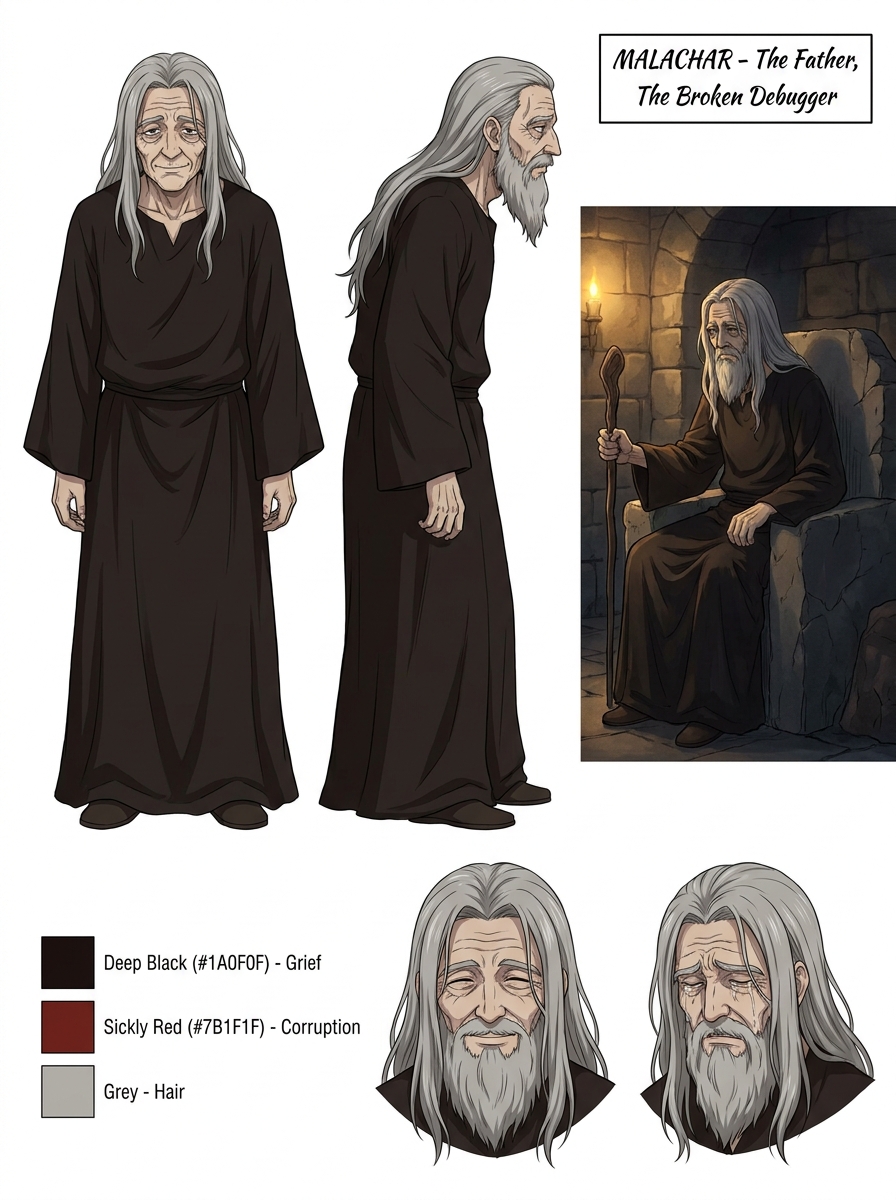
In which our protagonist enters Malachar's mind, and learns the full story of a programmer who lost his family.
The debugging began on a Sunday, because Sundays were Kenji's, and this was the most important debugging of his life, and the most important debugging of his life began, the way all the important debuggings had begun, with a function call and a closed pair of eyes.
He sat in the inner sanctum, across from Malachar, with the team around him, with the Compiler ready, with the new world pulsing. He had designed a spell, the most personal spell he had ever designed, a spell that would let him enter the mind of the man who had built the world, see the bug, hold the grief, let him rest. He had named the spell in the language the team had built together, the language of structured magic and dry systems humor, the language of a developer who had been speaking it for nine seasons.
"Function enter_mind(target=Malachar, scope=full_memory, hold_grief=true, fix_bug=false, leave_love=true)."
The spell was cast. Kenji closed his eyes. He was in.
[Spell active: enter_mind]
[Target: Malachar. Layer: 3,199 of 3,200. Scope: full memory, including the sealed room.]
[Compiler note: the sealed room is, in a small way, the most important room in the world. The system is, in a small way, afraid.]
The system was afraid. The system had, in nine seasons, learned the particular kind of fear that comes from opening a file the file has been telling you, in the driest possible language, that you are not ready to read. The system opened it anyway, because the developer had asked, and the developer was, in a small way, ahead of the system.
Malachar's mind was a forest.
The same forest. The forest where Kenji had woken up, nine seasons ago, when he had died in Tokyo and had arrived in this world with a system in his head and a Compiler that had called him, in a tone that was, in a small way, ahead of him, the developer. The forest was the first thing Malachar had coded, the first thing he had built, the first thing he had given to the world. The forest was, in a way Kenji had never been able to put into language, the love made visible.
The trees were tall. The grass was soft. The two moons were in the sky, hanging low like the eyes of curious cats, the way the two moons had been hanging in the sky since the day Malachar had first written them there for a seven-year-old girl who liked to count them. The air smelled like cedar and honey. The air smelled like the first morning Kenji had woken up in this world, the morning he had run from the fourth goblin, the morning the system had told him, in the driest possible language, that he was not the user.
In the center of the forest, there was a small house. A wooden house, with a thatched roof, with a chimney that was smoking, with a garden in the front where flowers were growing in rows so careful they could have been measured by a programmer who believed, in his heart, that the world should be a place where flowers were a system and not an accident.
A woman was in the garden. She was young, with dark hair, with kind eyes, with a smile that was the kind of smile that makes the world feel like it is worth living in, the way a working build makes a developer feel like the job is worth the meetings.
A girl was running through the garden. She was seven years old, with bright eyes, with a laugh that was the kind of laugh that makes the world feel like it is worth saving, the way a clean test suite makes a debugger feel like the system is worth the years.
"Papa!" the girl called. "Papa, look at the stars!"
Malachar was in the garden, looking up at the stars, holding his daughter in his arms. He was younger, in the memory. His hair was not grey. His face was not tired. His eyes were the eyes of a man who had built a world for his family and was being told, by his daughter, that the world was good.
"They are like the code, papa," the girl said. "All connected. All holding each other up."
"Yes," Malachar said. "Like the code. Like the world. Like us."
Kenji watched. He held the memory. He did not interfere. He was there to see, not to change, the way a debugger is there to see the system, not to argue with it.
[Memory: stable. Subject: daughter. Name on file: Elara. The Compiler note: this is, in a small way, the only memory the system has ever had to log twice.]
The system had logged the daughter's name. The system had, in a small way, recognized the name. The system had decided, in the driest possible language, not to log why the recognition was important, because the why was the kind of why a system leaves to the developer to figure out, in a small way, on his own.
The memory moved. Time passed. The garden grew. The girl grew. The woman grew older in the way women grow older in the gardens of small wooden houses built by men who love them, the way of slow Septembers and warm bread and the particular softness of a life being lived correctly. The man grew older. The world grew. The code grew. The love grew, in the way the love grows when the love is the foundation of the world and the foundation is strong.
Then the sickness came.
The girl was in bed. She was pale. She was tired. The sickness was in her, the kind of sickness that no code could cure, the kind of sickness that comes from nowhere, the kind of sickness that takes everything. The woman was at the bed, holding the girl's hand, praying, doing everything a mother does when her child is dying and the world the father built cannot save the child. The man was at the desk. He was writing code. He was rewriting the world. He was trying to debug the unsolvable bug. He was trying to do what the through-line said was possible, the through-line he had been saying to himself since the day the love had first been enough: solve any sufficiently well-defined problem.
The bug was not sufficiently well-defined. The bug was entropy. The bug was time. The bug was the thing no code can fix, the thing no love can save, the thing no debugging can debug, the thing a father learns the night his seven-year-old daughter stops breathing in a bed in a wooden house in a forest at the edge of the world.
The girl died. The woman died, shortly after, of grief, of the grief of losing a child, of the grief of watching a man she loved go mad with the loss. The man was alone. The man was at the desk. The man was writing code into the foundation of the world, and the code was wrong, and the code was grief, and the code was the love that did not save made into storms and floods and droughts and earthquakes and a void that opened at the bottom of the world and a cult that worshipped the void because the cult had forgotten that the love had ever been the love.
The man went to the World Root. The man lay down in the place where the code was generated, in the place where the love had begun, in the place where a seven-year-old girl had once said that the stars were like the code. The man closed his eyes. The man slept.
The man slept for a thousand years. The man waited, in the sleep, for someone to come. The man waited for a debugger. The man waited, in the driest possible language, for someone to do the only thing the love had ever been for.
Kenji opened his eyes. He was back in the inner sanctum, with the team, with Malachar, with the new world pulsing.
[Spell complete: enter_mind. Memory integrated. Bug: located.]
[Compiler note: the bug is, in a small way, the only bug the system has ever had to log at the bottom of a man. The system is, in a small way, ahead of the developer.]
"I have seen the bug," he said.
Malachar was looking at him, in the candlelight, with the tired eyes of a father who had just been seen, for the first time in a thousand years, by someone who had not been told to look away.
"What is the bug?" Malachar asked.
"The bug is the loss," Kenji said. "The love is not the bug. The grief is not the bug. The bug is the thing the love could not save. The bug is the seven-year-old girl. The bug is the night she stopped breathing. The bug is the thing no code can fix. The debugging is not the fixing. The debugging is the holding. The love is the love. The grief is the grief. The debugging is holding both."
Malachar was quiet. Then he said, in a voice that was, in a small way, ahead of the man who had spoken it: "I am ready to rest. I am ready to let you hold the grief. I am ready to let the love be the love."
The team did not speak. Pip pulsed, very softly, on his shoulder, in a pulse that felt like the only thing the kernel of the new world had ever had to say about a father who had lost his daughter: I am here. I see you. The debugging is the work. The work is the love. The love is the only thing the world has ever had, in a small way, the only thing the kernel has ever had, in a small way, the only thing the developer has ever had, in a small way, the home.