Post-Credits Scene
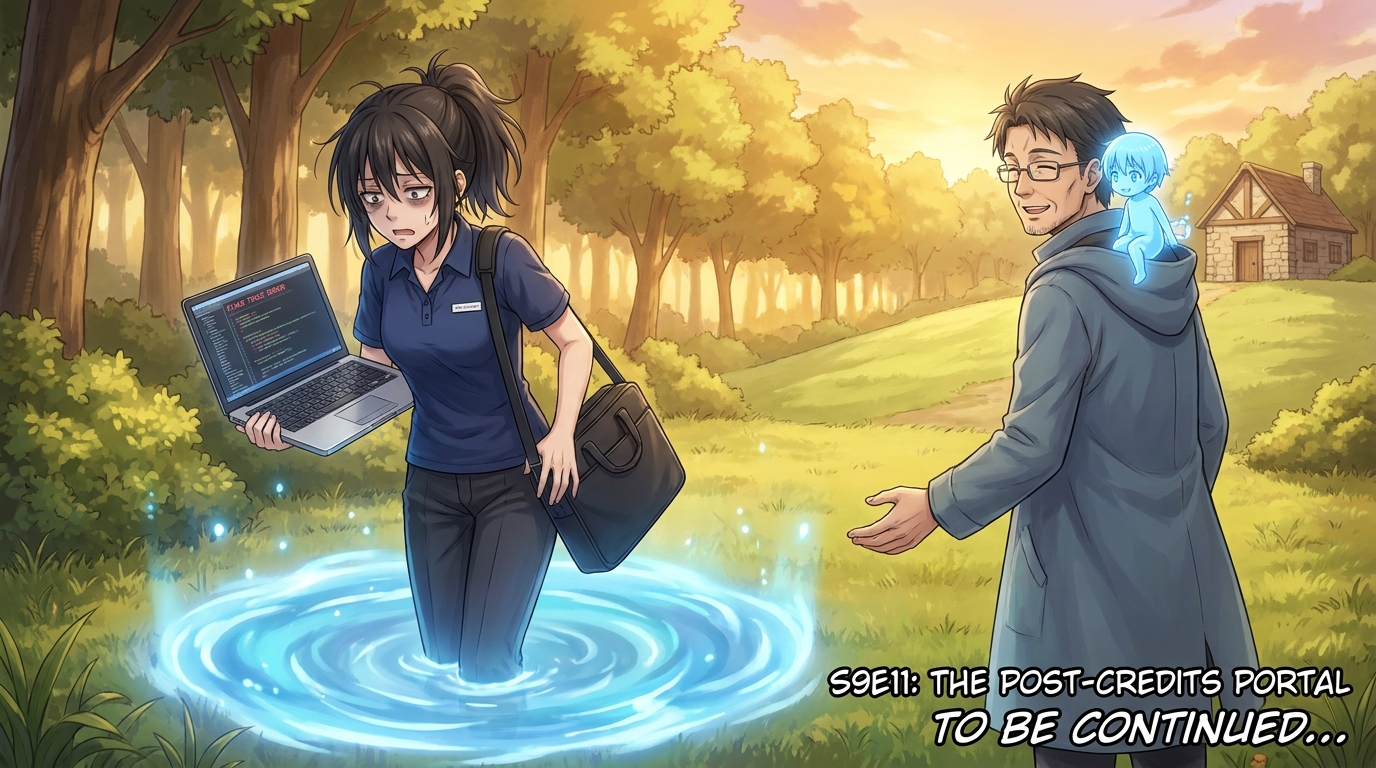
In which a young woman stumbles through a portal, and the series hints that the story is not over, and the debugging begins again.
The credits rolled. The names scrolled by, the way credits scroll by in a series that has been telling the same story for nine seasons, the way credits scroll by when the credits are, in a small way, the only kind of summary the system has ever had to log at the bottom of a world. The Strange Sage. Captain-Commander Elara Vance. First Architect Lian. The Abundance. The Unity. Pip, the Guardian. The Original Programmer, at rest. The Debuggers. The Team. The four children, asleep. The single moon, overhead. The new world, at peace.
Then the screen was black. The music was quiet. The credits were done.
A portal opened.
It was a small portal, no larger than a doorway, in the middle of the new world, in the middle of the forest where Kenji had first woken up nine seasons ago, where the fourth goblin had told him the system was his, where the two moons had once hung in the sky like the eyes of curious cats. The portal was not green, not the corruption. The portal was blue, the color of clean mana, the color of a debugger's screen at 3 AM, the color of Compiler v0.1.0 on the night the Compiler had first loaded and had decided, in a small way, that the developer was not the user.
A young woman stumbled through.
She was in her mid-twenties, with dark hair, with a laptop bag over her shoulder, with the kind of expression that a person has when they have been working on a production system for too long and have not slept in days, the kind of expression that Kenji had worn, once, in Tokyo, in an office, on the morning of the demo, when the pull request had not been merged and the truck had been coming. She was wearing the uniform of a tech company. She was holding a laptop. The laptop was still on. The screen showed a debugger, a paused process, a stack trace. The stack trace was the pull request that Kenji had not merged before the demo, the pull request that had been the last thing he had thought about before the truck had hit him, the pull request that had been the seed of the entire story.
She looked at the new world. She looked at the forest. She looked up at the sky, where two moons should have been and where one moon was, the one that was the moon of a debugged world, the one that was the only moon the system had ever had to log at the bottom of a man.
"What the..." she said, in the way a person says what the when the person has just stumbled through a portal and is standing in a forest and is holding a laptop that is showing the stack trace of a bug that was committed in a world the person no longer recognizes.
An old man was walking down the hill, with a small bright child on his shoulder, with a kind smile, with the kind of presence that only a debugger who has debugged a world can have. He was wearing a coat that was faded and mended and loved. He had a small leather journal in his hand. He had the kind of eyes that have seen too much and have decided, in a small way, that the seeing is the only honest work the eyes have ever had to do.
He stopped in front of her. He looked at her. He looked at the laptop. He looked at the stack trace.
He smiled. It was a real smile, the kind that reached his eyes, the kind that made the world feel like it was worth being in, the kind a developer smiles when the developer has just been told, in the driest possible language, that the debugging is not over, and that the debugging has never been over, and that the debugging is the work, and that the work is the love.
"Hello, World," he said. "Welcome to the kernel."
He held out his hand.
She looked at him. She looked at the hand. She looked at the small bright child on his shoulder, who was glowing faintly, the way a small bright presence glows when the presence has been a dragonfly and a spark and a kernel and a child. She looked at the new world, at the single moon, at the forest, at the hill with the small house, at the school, at the four small shapes in the garden that were, in a small way, the next generation.
"Hello," she said. "I am from the corrupted instance. I am from the old world. I am from the world of the truck and the salaryman and the Tokyo dawn. I have been debugging the corrupted instance for years. I have been trying to fix the bugs. I have been trying to save the world. I have been failing. I have been going mad with the failing. I have been the bug."
He looked at her. He looked at the laptop. He looked at the stack trace. The stack trace was the pull request. The pull request was the seed. The seed was, in a small way, the only seed the system had ever had to log at the bottom of a world that had been debugged and was now, in a small way, being asked to be debugged again.
[Compiler v∞: receiving new developer. Initialization: complete. Source: corrupted instance. Status: not alone.]
[Compiler note: the system is, in a small way, ahead of the developer. The developer is, in a small way, learning. The learning is, in a small way, the only thing the system has ever had to log at the bottom of a story that is, in a small way, just beginning.]
The system approved. The system was, in a small way, a colleague, and the colleague had just told him, in the driest possible language, that the new developer was here, and the new developer was not alone, and the new developer was, in a small way, the only developer the system had ever had to log at the bottom of a story that was, in a small way, the only story the system had ever had to compile, and the compiling was, in a small way, the only work the developer had ever had to do, and the work was, in a small way, the love.
"You are not the bug," he said. "You are the debugger. You are the next debugger. You are the next Strange Sage. The debugging is not over. The debugging is never over. The debugging is the work. The work is the love. The love is the only thing that has ever held the world together."
She looked at him. She looked at the small bright child. She looked at the new world.
"Teach me," she said. "Teach me the through-line. Teach me the love. Teach me the debugging. Teach me how to hold the grief. Teach me how to be a debugger."
He smiled. He took her hand. He led her up the hill, toward the small house, toward the team, toward the four women who were sitting on the porch, toward the four children who were asleep in the small house, toward the future that was, in a small way, the only future the system had ever had to log at the bottom of a story that was, in a small way, just beginning.
"Function create(name=new_debugger, inputs={target=corrupted_instance}, outputs={debugged_world}, cost=high, stability=very_high, hold_grief=true, leave_love=true)."
The spell was cast. The debugging began. The new world was the foundation. The corrupted instance was the new project. The team was growing. The love was the answer.
The single moon shone over the new world. The new world was at peace. The new world was, in a small way, the only world the system had ever had to compile when the love had been the love and the debugging had been the debugging and the developer had been the developer and the story had been, in a small way, just beginning.
The screen was black. The music was quiet. The story was not over.
The story was, in a small way, just beginning.