Epilogue, Part 2
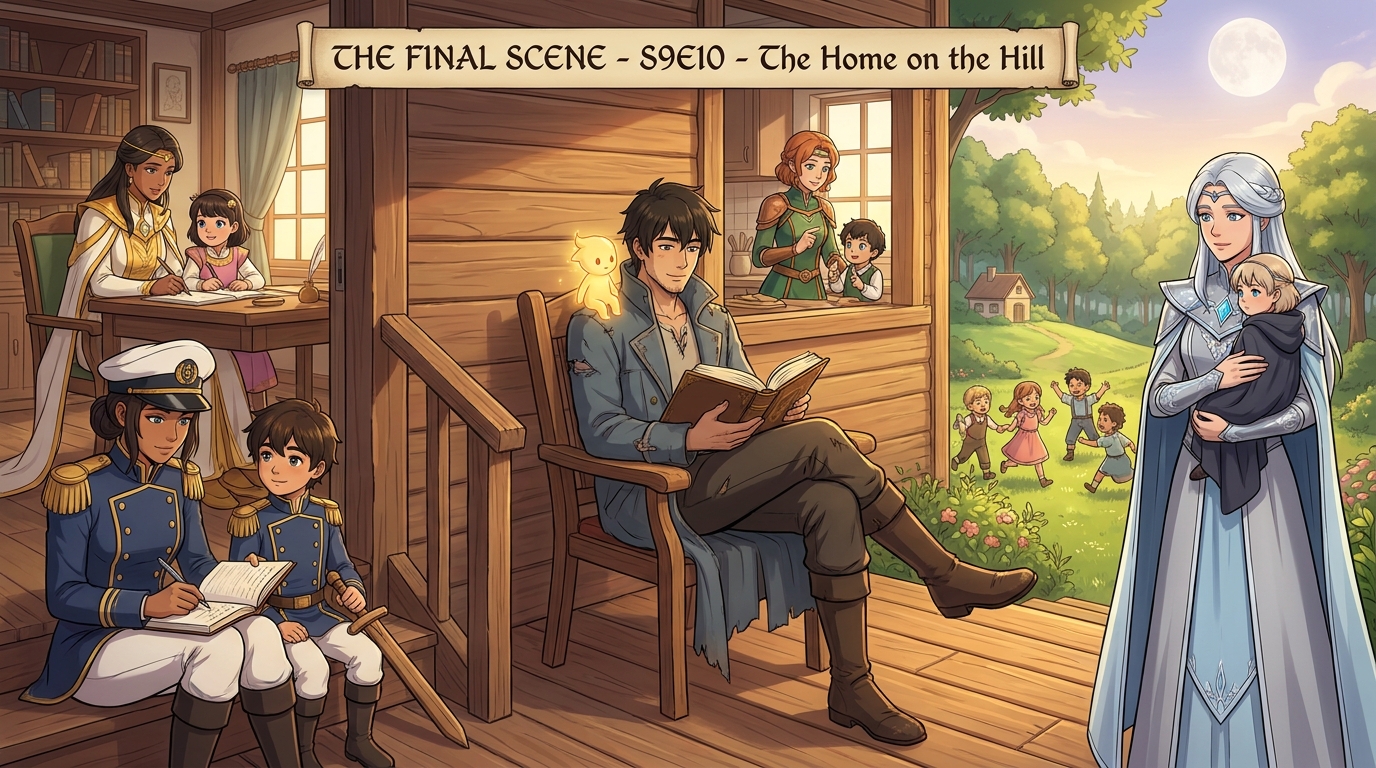
In which our protagonist's family is shown, the journal entry is written, and the series ends.
The final scene of the series takes place on a Sunday, on a hill, in a small house, in the new world, in the place where the debugging was finished, in the place where the love was the answer.
Kenji sat on the porch of the small house, with the team around him, with the four children playing in the garden, with Pip-the-child sitting on his shoulder, with the view of the forest where he had first woken up, with the single moon overhead, with the new world at peace.
Elara was beside him, on his right, in the chair that she had claimed as her own. She was older now, her hair streaked with grey, her sword still at her hip (the new one, with the king's father's sword mounted on the wall). She was reading a book. She was, as she had always been, the wall.
Lian was on the grass, with the four children, teaching them how to read the source code, how to debug, how to hold the love and the grief together. She was, as she had always been, the architect.
Seraphina was in the kitchen, making tea, with the kind of efficiency that only a merchant can have. She was, as she had always been, the abundance.
Calla was on the porch, on the left, looking out at the world, with the kind of calm that only a leader can have. She was, as she had always been, the unity.
The four children were playing. They were each named for the parents' love.
Kai, the son of Kenji and Elara, was seven years old. He had his mother's fierce eyes, his father's analytical mind. He was practicing sword forms in the garden, with a wooden sword, with the kind of focus that only a warrior's son can have.
Mira, the daughter of Kenji and Lian, was six years old. She had her mother's dark hair, her father's quiet determination. She was sitting beside Lian, learning to read the source code, with the kind of focus that only a mage's daughter can have.
Ren, the son of Kenji and Seraphina, was five years old. He had his mother's sharp eyes, his father's gentle heart. He was helping in the kitchen, learning to count, learning to negotiate, with the kind of focus that only a merchant's son can have.
Astra, the daughter of Kenji and Calla, was four years old. She had her mother's royal bearing, her father's sense of humor. She was sitting on Pip-the-child's lap, listening to a story, with the kind of focus that only a leader's daughter can have.
Pip-the-child was telling the story. The story was the story of the debugging, the story of the through-line, the story of the love that does not save but is still worth giving. The story was the story that Kenji had told the team, in the small room, on the chair, in the office, in the years of the alliance, in the years of the rewrite. The story was the story that the new world needed to hear.
The story was the story of a man who had died in another world and woken up in this one, who had fixed a clock, who had built an aquifer, who had defended a town, who had audited a kingdom, who had built an alliance, who had saved a continent, who had lost a healer, who had lost a king, who had lost a dragonfly, who had found a team, who had found a family, who had debugged a world, who had rewritten a world, who had deployed a new world, who had refused a crown, who had chosen a chair.
The story was the story of the love.
The story ended. The children went to bed. The team sat on the porch, in the dark, in the quiet, in the new world.
Kenji took out a journal. He opened it. He wrote:
The best code is the one that creates peace.
System: Stable.
Deployment: Successful.
He closed the journal. He put it down. He looked at the team. He looked at the world. He looked at the single moon.
"System status," he said, for the last time, in the new world, in the series.
[System: stable]
[Compiler: absorbed]
[Threat: gone]
[Allies: at peace]
[Mood: home]
[Pip: here]
[Status: complete]
"Deploy," he said, for the last time.
The night went on. The single moon shone. The new world was at peace.
The series was complete.
End of Season 9
Kenji has gone from royal advisor to the God of Order. But he refused the crown. He chose a chair. He is a teacher, a debugger, a man who takes Sundays off and reads books in chairs. He is married to four women. He has four children. He has a small house on a hill, overlooking the forest where he first woke up.
The debugging is complete. The deployment is successful. The new world is at peace.
Pip is reborn as a child, the guardian of the next generation. Malachar is at rest. The chaos god is at peace. The original programmer is dreaming of his daughter.
The through-line is true. The love is the answer. The team is the difference. The debugging is the work. The work is the love. The love is the only thing that has ever held the world together.
The series ends. The story is told. The world is debugged.
Post-credits scene to follow.
End of Season 9.
Last-line callbacks and what they set up for the post-credits:
- "The system: stable. The deployment: successful" is the through-line's final restatement. The principle is complete.
- Pip is "here" is the seed of the post-credits scene. Pip is still here.
- "The new world is at peace" is the seed of the post-credits scene. The new world is at peace. The corrupted instance is gone. But a portal opens.
- "The series ends. The story is told." But the post-credits scene says: the story is not over. The corrupted instance is not entirely gone. A young woman stumbles through. The debugging continues.