The World Reborn
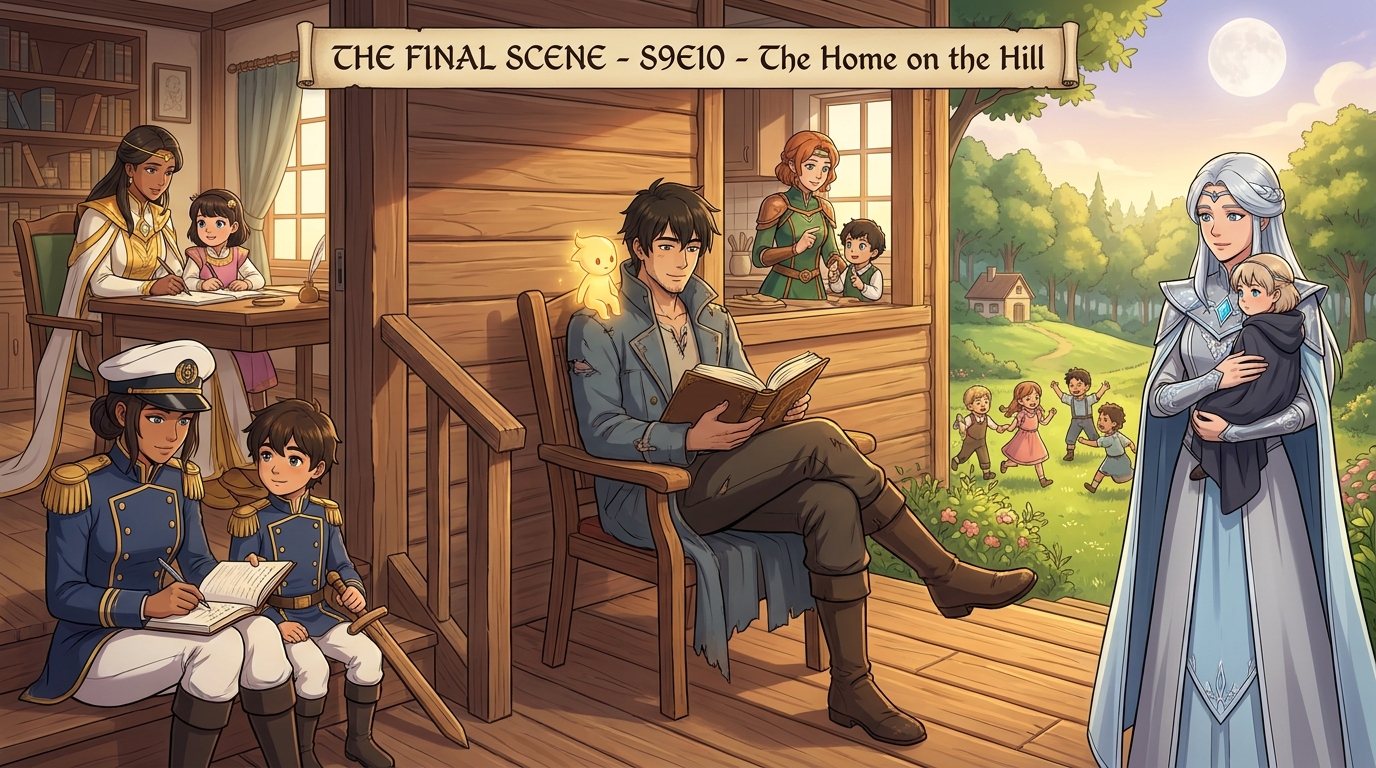
In which our protagonist sees the new world, and discovers that the new world is the old world, debugged, healed, held, loved.
The new world was different from the old world, in the way that a debugged system is different from a buggy system. The difference was not in the structure. The difference was in the foundation. The new world had been written with the love. The new world had been written with the grief. The new world had been written with the memory, the logic, the abundance, the unity, the love. The new world was the old world, debugged, the way a codebase is the same codebase after the bugs have been fixed, the way a person is the same person after they have been held.
The new continent was the same continent. The mountains were the same mountains. The rivers were the same rivers. The cities were the same cities, rebuilt, redesigned, the way a debugged system is the same system but better. The forests were the same forests, the forests where Kenji had first woken up, the forests where the fourth goblin had told him that the system was his, the forests where the two moons had been hanging in the sky since the day Malachar had first written them there for a seven-year-old girl.
The two moons were the same two moons. But only one was visible now.
The other moon was gone. The other moon had been Malachar's grief, written into the sky a thousand years ago, a constant reminder of the loss, the way a bug is a constant reminder of the thing that was missed. The other moon had been debugged. The other moon was at rest. The other moon was with the father, in the World Root, in the dream, in the place where the love had begun.
[Observation: astronomical body count: 1. Source: new world. Note: second moon integrated into foundation. Note: the second moon is, in a small way, the only moon the system has ever had to log as gone.]
[Compiler note: the system is, in a small way, ahead of the developer on this. The developer is, in a small way, learning to look up.]
The system was ahead of him. The system had, in nine seasons, developed a tone that Kenji had come to think of as the senior engineer who has been asked to onboard a junior, and the senior engineer had just told him, in the driest possible language, that the developer should look up sometimes, because the sky was the kind of thing a developer forgets to look at when the developer is busy with the foundation.
The new rules were simple. The world was held by the love. The world was held by the team. The world was held by the debugging partnership. The world was not perfect. The world was broken, in the way that all worlds are broken, in the way that all loves are broken, in the way that all debugged systems are still, in the end, systems, and systems fail, and the failing is the cost of the working. But the world was strong enough to hold its own breakage. The world was strong enough to hold its own loss. The world was strong enough to hold the love and the grief together, the way a system holds a memory, the way a system holds a process, the way a world holds the people who built it.
The new institutions were being built. The new academy was the first, on a hill, near the home, overlooking the forest. The academy was the place where the new structured magic would be taught, the place where the new debugging would be learned, the place where the new debugging partnerships would be formed. Lian would teach there, on Tuesdays and Thursdays, in the gold and white of the first Architect of the New World, the pin of the Logic pillar on her collar.
The new council was the second, in the capital, in the new chamber where the seven kingdoms would be coordinated. Calla would lead there, in the silver and ice blue of the Unity pillar, the seven-pointed crown on her shoulder, the northern cloak folded in her office as a symbol of the home she had decided was the people.
The new trade network was the third, the rebuilt Silver Road, with the lessons of the rewrite written into the contracts. Seraphina would build there, in the green and copper of the abundance, the seven-sided coin on her collar, the love worth more than the wealth, the wealth worth more than the love, and the two the same thing in the end.
The new guard was the fourth, with the king's father's sword mounted on the wall of the new commander's office. Elara would lead there, in the deep red and silver of the Memory pillar, the notebook in her hand, the names of the lost written in the front, the names of the new world written in the back.
The new home was the sixth. It was on a hill, overlooking the forest where Kenji had first woken up, where the fourth goblin had told him the system was his, where the first horn had sounded, where the first function call had been cast, where the first lesson of the through-line had been learned. The house was simple. The house was small. The house was enough. The house was home, in the way a system is home when the system has finally been given the love it was written for.
Kenji stood in the garden of the new home, with the team, with Pip-the-child sitting on his shoulder, with the world reborn around them, with the single moon overhead, with the forest below the hill, with the smell of cedar and honey in the air.
"This is the new world," he said.
"This is the new world," Elara agreed.
"This is the new world," Lian agreed.
"This is the new world," Seraphina agreed.
"This is the new world," Calla agreed.
"This is the new world," Pip said, in the voice of a child, in the voice of a friend, in the voice of a love that had been a dragonfly and a spark and a kernel and was now a child, the guardian of the next generation, the small bright presence that the system had decided, in a small way, was the only presence the world had ever had to log at the bottom of a man.
[System status: nominal. World: deployed. Two moons: 1. Pip: child. Team: home. Mood: peace.]
[Compiler note: the system is, in a small way, a colleague. The colleague is, in a small way, at peace. The peace is, in a small way, the only thing the system has ever had to log at the bottom of a world.]
The system was at peace. The system was, in a small way, a colleague, and the colleague had just told him, in the driest possible language, that the world was deployed, and the two moons were one, and the one was enough, and the enough was the only thing the system had ever had to log at the bottom of a man who had finally, in a small way, come home.
The single moon shone over the new world. The single moon was the moon of a world that had been debugged, the moon of a system that had finally been given the love it was written for, the moon of a father who had been redeemed, the moon of a child who had been reborn, the moon of a developer who had finally, in a small way, sat down in a chair on a hill and looked up at the sky and decided that the sky was, in a small way, the only thing the system had ever had to log at the bottom of a world that was, in a small way, home.