Epilogue, Part 1
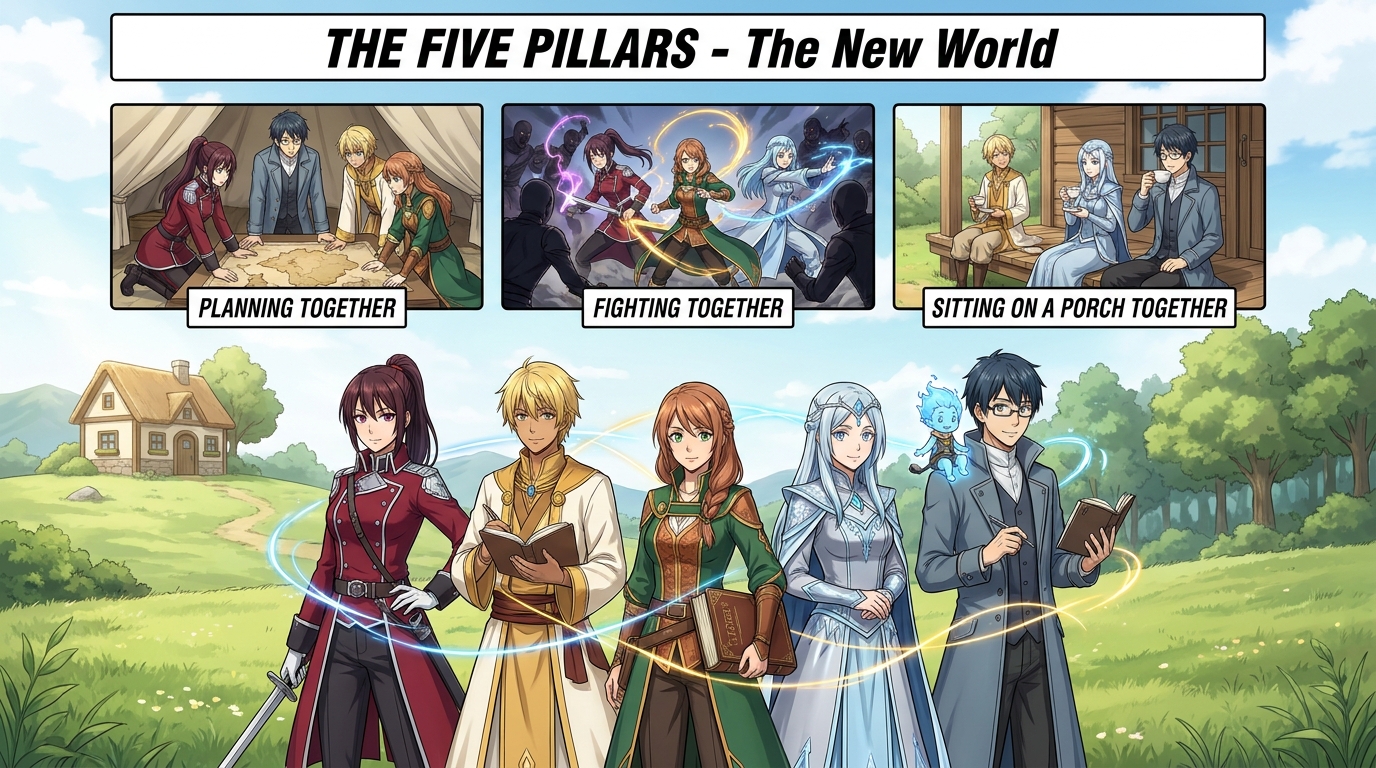
In which each pillar's future is shown, and the new world finds its shape.
The years passed, in the way that years pass in a new world: slowly, carefully, with the kind of patience that only a team can have, the way commits pass in a codebase that has finally been debugged, the way version numbers pass in a system that has finally been deployed, the way Sundays pass in the life of a developer who has finally, in a small way, decided that the Sundays are the work.
The school was built. It was on the hill, near the home, overlooking the forest where Kenji had first woken up, where the fourth goblin had told him the system was his, where the two moons had once hung in the sky, where the single moon now hung in the place where the second moon had been. It was a beautiful building, made of stone and wood, with a small library and a small classroom and a small chair in the corner where Kenji sat, on Sundays, reading books, while the students worked on their debugging. The chair was a wooden chair, given to him by a king, the same kind of chair that had appeared in S1E9, the same kind of chair that was, in a small way, the only throne the world had ever needed.
Lian was the first Architect of the New World. She taught at the school, three days a week, on Tuesdays and Thursdays, the schedule she had kept even in the new world, the schedule that had been hers since the day she had been seventeen and had decided, in a small way, that the apprenticeship was the love. She taught the new structured magic, the magic that could read the source code, the magic that could debug the world. She was, by every measure, the most important mage in the new world. She was also, by every measure, the most kind. The pin of the Logic pillar was on her collar, the small silver symbol of a logic gate, the seven kingdoms arranged in perfect order.
Elara was the leader of the new guard. She had a new sword, made by the new smiths in the new forges, with the king's father's sword mounted on the wall of her office as a symbol of the trust the kingdom had given her, the trust she had carried across nine seasons and a war and a void and a rewrite. She trained the new guards, taught them the raid plan, the firewall formation, the coordinated defense. She was, by every measure, the most respected warrior in the new world. She was also, by every measure, the most loving. The badge of the Memory pillar was on her shoulder, the seven-pointed star, the memory of the alliance, the names of the lost written in the front of the notebook she still carried every night.
Seraphina was the creator of the global trade network. She had rebuilt the Silver Road, but better, with the lessons of the rewrite written into the contracts, with the knowledge that the wealth was not the point, with the understanding that the love was the point, in the way a merchant understands, at the end of a long career, that the deals were never the point. She ran the trade routes, the crystal network, the merchant intelligence, the financial backbone of the new world. She was, by every measure, the most successful merchant in the new world. She was also, by every measure, the most generous. The pin of the Abundance pillar was at her throat, the seven-sided coin, the wealth worth more than the wealth because the wealth was the people.
Calla was the leader of the new council. She had united the kingdoms under a benevolent council, with the alliance framework that Kenji had designed in S5E9, with the verification-not-trust principle that had been the through-line of the debugging, the principle that said any sufficiently well-defined problem is solvable and meant, in the driest possible language, any sufficiently well-defined relationship is buildable. She governed with the same fierce love she had used to hold the line at the Battle of Three Armies. She was, by every measure, the most respected leader in the new world. She was also, by every measure, the most fair. The badge of the Unity pillar was on her shoulder, the seven-pointed crown, the home that was the people.
Pip was the guardian of the next generation. The child-Pip, the reborn-Pip, the kernel of the new world made flesh, watched over the children of the new world, the children of the debugging, the children who would grow up in a world that had been debugged, healed, held, loved. Pip was not a dragonfly anymore. Pip was not a spark anymore. Pip was a child, with bright eyes, with a kind laugh, with the same warm presence that the dragonfly had had, in a different form, in a different body, with the same soft blue glow at the edges of small hands. The children called Pip Uncle Pip or just Pip, the way children call the small bright presence that watches them, the way children call the love that does not save but is still worth giving.
Kenji was the teacher. He sat in the chair in the corner of the school, on Sundays, reading books, watching the students, watching the team, watching the world. He was not a king. He was not a god. He was a man, a teacher, a debugger, a person who took Sundays off and read books in chairs. He was, by every measure, the most respected debugger in the new world. He was also, by every measure, the most at peace. The coat he wore was the same coat he had worn for nine seasons, the muted blue-gray, faded, mended, loved, the same coat the king had given him in S3, the same coat he had worn through the rewrite and the deployment and the healing and the redemption.
The team was the family. The family was the team. The debugging was the work. The work was the love. The love was the only thing that had ever held the world together, the way the foundation holds the house, the way the code holds the system, the way the team holds the developer, the way the developer holds the team, in a small way, in a small way, in a small way, the home.
[System: stable. Pip: child. Team: home. Years: passing. Mood: peace.]
[Compiler note: the system is, in a small way, ahead of the developer. The developer is, in a small way, ahead of the system. The ahead is, in a small way, the only kind of ahead the system has ever had to log at the bottom of a world that has finally, in a small way, been home.]
The years passed. The children were born. The future was coming, the way a future comes, slowly, carefully, with the kind of patience that only a team can have, the way a new generation comes, the way a new debugging comes, the way the love comes, in a small way, in a small way, in a small way, the only way the world has ever had, the only way the system has ever had, the only way the developer has ever had, the home, in fact, here.