The First Casualty
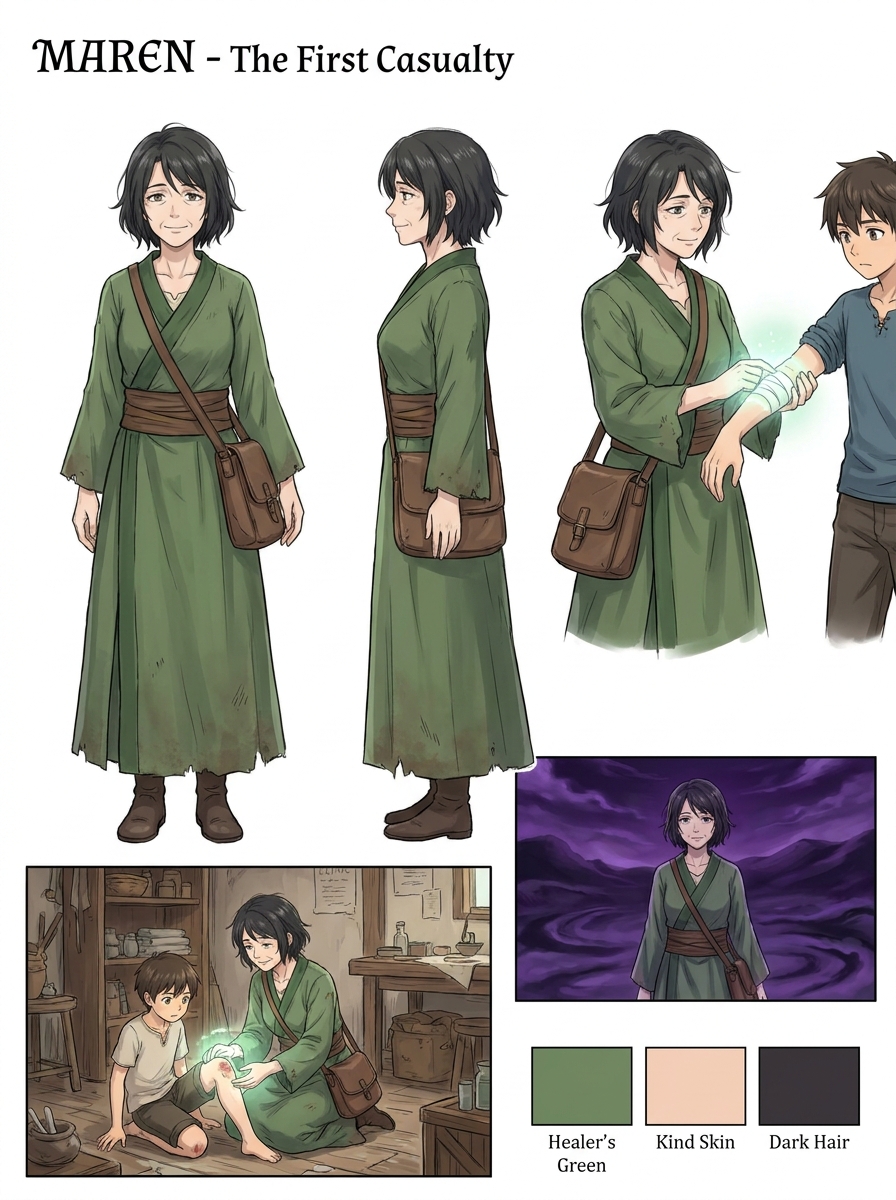
In which our protagonist loses a healer who stayed behind to help, and learns that the cost of debugging is, in a small way, paid in people.
Maren died on a Wednesday, and the world did not stop, and the void did not pause, and the crystal network did not, in the driest possible language, log a single line of condolence, and the condolence was, in a small way, the kind of condolence the system was, in a small way, going to be remembering for the rest of the season.
Lian heard it first. She was at the World Root, with her hand on the source code, with her eyes closed, with the look of a person who had been reading the world's foundation for weeks. She came into the command tent at dawn, and her face was the face of a person who had just read the worst line of code she had ever read, and the worst line was a name, and the name was Maren, and the name was a healer, and the name was a person who had believed in the through-line, and the through-line had not been enough to save her.
"Maren is dead," she said.
[detect_personnel: 1 source lost. Composition of loss: Maren, healer, southern clinic, refugee evacuation.]
[Compiler note: Maren stayed behind to help children, elderly, and wounded who could not travel. Maren believed the through-line was enough. The through-line was not, in this case, enough.]
Kenji was sitting in the field chair, the one he had brought south with him, the one that had been his throne for three days, the one that was starting to feel less like a chair and more like a small private country. He did not move. He did not speak. He looked at the ground. He thought about the healer he had met at the southern council two seasons ago, the healer with the steady hands and the patient voice, the healer who had been one of the people who had helped build the systems that had held the world together for two seasons. He thought about the fact that Maren had been a debugger, in her way, the way all healers are debuggers, the way all people who stay behind to help are debuggers. He thought about the fact that the through-line was true, that any sufficiently well-defined problem was solvable, but that some problems took the people who tried to solve them.
"I should have told her to evacuate earlier," he said, finally.
"You did," Elara said, from the doorway. "She refused."
"I should have gone to get her."
"You could not. You were here. The void was there. There was not time."
"I should have made the void smaller. I should have redirected it. I should have done something."
"You did everything you could." Lian's voice was soft. "The void is not your fault. The void is Malachar's fault. The void is the corruption's fault. The void is not the debugger's fault. You debugged. You held the line. You saved millions of people. You could not save Maren. That is not a failure. that is the cost."
[Compiler note: this is the senior engineer who has been asked to onboard a junior to the cost. The system is, in a small way, paying attention.]
[Compiler note: the cost is real. The cost has always been the cost.]
"The cost is too high," he said.
"The cost is what it is," Lian said. "The cost is the people who stay behind. The cost is the people who cannot be saved. The cost is the people who give their lives so that others can live. That is the cost. It has always been the cost. It will always be the cost."
He stood up. He walked out of the tent. He walked to the edge of the camp, to the place where the southern horizon met the void, the place where the shimmer was faint and getting fainter, the place where the file was being deleted. He looked south. He thought about Maren, who had been a good healer, who had been a kind person, who had stayed behind to help the children who could not travel, the elderly who could not move, the wounded who could not be carried. He thought about the through-line. He thought about the fact that the through-line was true, that any sufficiently well-defined problem was solvable, but that the problem of saving a clinic full of children while the world was being deleted was, in the small specific way a person who has read the documentation of a failing system understands, the kind of problem that the through-line could describe but not, in this case, solve.
[Compiler note: developer is processing grief. Recommend: do not interrupt. The developer is, in a small way, learning that the cost is real. The system is, in a small way, a teacher.]
"Maren believed in the through-line," he said, quietly, to no one, to the void, to the world that had not saved her. "She believed that any sufficiently well-defined problem is solvable. She stayed behind because she believed that the children, the elderly, the wounded were problems she could solve. She was right. She solved them. She solved them until the void came. She solved them until the cost was her life."
He raised his hand. He cast a small spell, a light spell, the spell he had cast on his first night in this world, the spell that had been his first function call, the spell that had been his first hello, world. The light went up. It hung in the air for a moment, small and pale, a small bright point against the void. Then it flickered out, the way a person flickers out when the cost is paid, the way a name flickers out when the file is deleted.
"Hello, world," he said, softly. "Goodbye, Maren."
Pip's faint spark pulsed, very softly, in the back of his mind, the pulse feeling like: "The cost is real. The cost is paid in people. The debugging continues. The love is the only thing that has ever held the world together. Maren knew this. Maren lived this. Maren died this. The cost is the same. The love is the same. The debugging is the same."
Kenji sent back, in the language he and Pip had built together: "I know. I will not forget. I will not let the team forget. The cost will be remembered."
He turned back to the camp. He sat down in the field chair, which was a different chair, a chair that was starting to feel less like a chair and more like the place where the cost was logged. He opened the notebook, the small leather notebook he had carried since his first night in this world, the notebook where he had written the through-line a hundred times, the notebook where he had written the aquifer spell and the firewall spell and the audit spell and the through-line restated at every scale the through-line had ever been restated at. He opened it to a new page. He wrote, in the careful handwriting of a man who has been writing down things that matter since he was twenty-two: Maren. Healer. Believed in the through-line. Stayed behind to help. Died in the void. Cost: paid. Memory: held.
The debugging was not over. The debugging was, in a small way, the only thing that had ever held the world together. But the cost was real, and the cost was Maren, and the cost was the children, and the cost was the elderly, and the cost was the wounded, and the cost was everyone who could not be saved, and the cost was the kind of cost that a person who has been debugging for ten years does not, in a small way, ever get used to.
[Skill: grief_logging (passive, range: memory) acquired through use of new_function().]
[Compiler note: this is a function the developer did not ask for. The system is, in a small way, the senior engineer who has been asked to onboard a junior to the cost, and the senior engineer is, in a small way, the kind of senior engineer who has never, in a small way, seen this kind of cost before.]
[Compiler note: the developer is, in a small way, learning that the cost is paid in people. The system is, in a small way, a teacher, and the teaching is, in a small way, the kind of teaching that hurts.]
He closed the notebook. He looked at the team, at Lian and Elara and Calla, at the people who had been holding the line while he had been in the chair. He looked at Pip's faint spark, in the back of his mind, the spark that was, in a small way, the only colleague he had ever had who had never once asked him to be okay.
The void shimmered on the southern horizon, patient, vast, the kind of patient a system is when the system has decided, in fact, to keep deleting. Somewhere in the deeper code, in the place where the original programmer had written the foundations, the faint presence was stirring still, the way a debugger stirs when the system has decided, in fact, that the system is awake, and the awakening was, in a small way, the kind of awakening that was going to be remembered, in a small way, as the moment the cost became a name, and the name became a memory, and the memory became the thing the rewrite was, in a small way, going to be built to hold.