The Truth
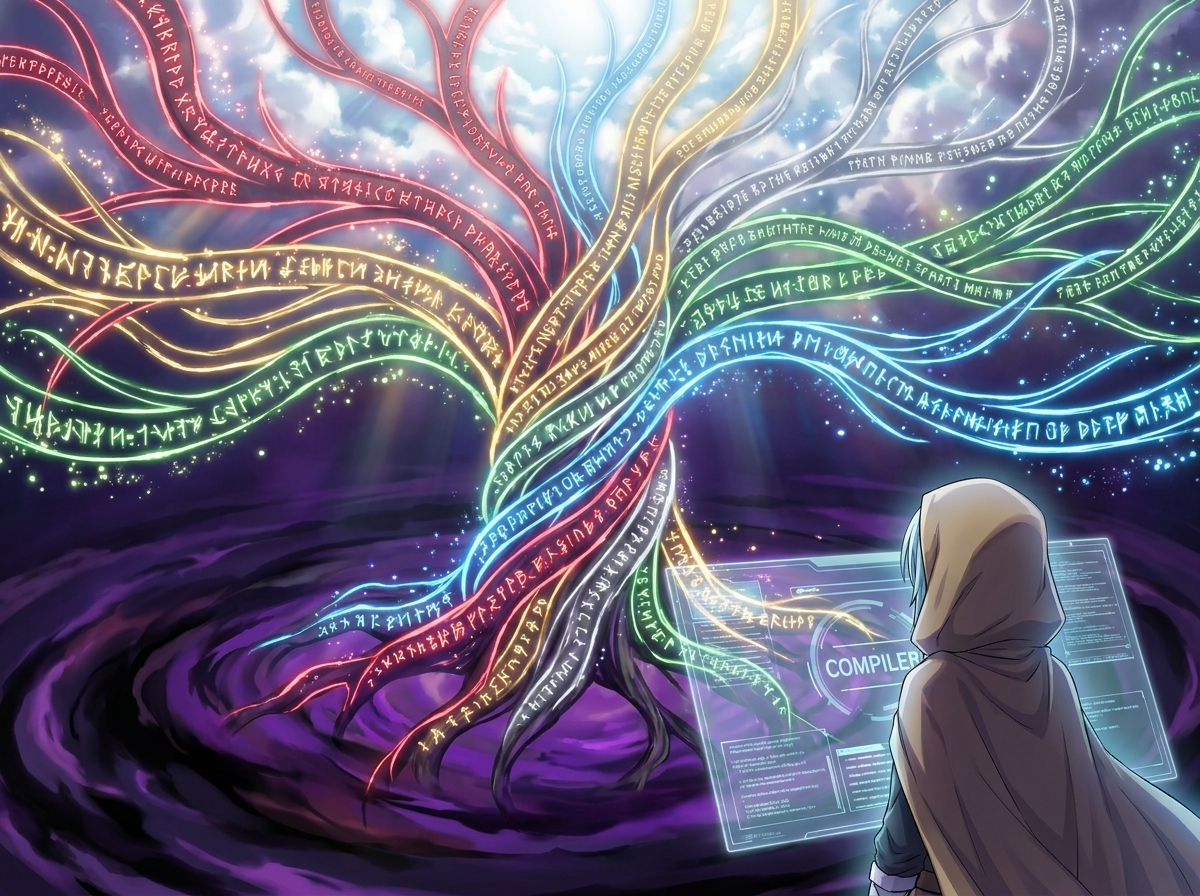
In which our protagonist learns the full truth about Malachar, and realizes that the antagonist of the story is also a victim of it.
The truth was not a single piece of information. The truth was a story.
Lian read it to them, in the ancient library, with the books and the scrolls and the crystals glowing around them. The story of Malachar, the world's original programmer, the man who had written the source code of reality.
His name had not always been Malachar. It had been something else, something human, something that the ancient library did not record. He had been a young man, in a small village, in a time before the kingdoms, before the churches, before the academies. He had been a programmer in the language of his world, which had been a kind of magic, which had been a kind of code, which had been the same thing.
He had fallen in love. He had married. He had a daughter. The daughter was his everything. He wrote the world's source code to protect her, to give her a world that would last, that would be safe, that would not have the sickness and the loss that he had known as a child.
Then the sickness came. Not the kind of sickness that magic could cure. Not the kind of sickness that code could debug. A sickness of the world itself, a sickness in the source code, a bug that Malachar had not seen when he had written the code. A bug that was killing his daughter, slowly, inevitably, in a way that no amount of code could fix.
He tried everything. He rewrote the code. He patched the code. He debugged the code. He did everything that Kenji had done in his own career, everything that the through-line demanded. He was the original debugger. He was the one who had written "any sufficiently well-defined problem is solvable" into the source code of reality, because he had believed it, because he had needed to believe it, because his daughter's life depended on it.
The bug was not solvable. The bug was not sufficiently well-defined. The bug was entropy, was time, was the simple truth that all things end, that all code has bugs, that all worlds have loss. The bug was the bug that cannot be debugged, the bug that is part of the system, the bug that no amount of cleverness can fix.
His daughter died.
His wife died shortly after. Not of sickness. Of grief. Of the grief of losing a child, of the grief of watching the man she loved go mad with the realization that the code was not enough.
Malachar was alone. He had built the world. He had lost the people he had built it for. He had nothing left but the code, and the code was a reminder of what he had lost, and the code was full of bugs, and the bugs were killing the world he had built.
So he decided to delete it.
He did not delete it all at once. He corrupted it. He wrote the bugs into the foundation. He made the storms, the floods, the droughts, the earthquakes. He made the void. He made the corruption. He made all of it. He made it because he wanted to unmake what he had built. He made it because he wanted to start over. He made it because he wanted to write a new world, a world without the bugs that had killed his daughter, a world that would not have loss, a world that would not have grief.
He did not succeed. The corruption did not delete the world. The corruption just made it worse. The corruption made the world a place of suffering, of loss, of the very grief that he had been trying to escape. The corruption made the world exactly what he had been running from.
He retreated. He went to the source code, to the World Root, to the place where the world's code was generated. He did not delete the world. He went to sleep. He went into a long, deep sleep, in the place where the code was written, and he dreamed of a world without loss, and he waited for someone to come and finish what he had started.
For a thousand years, the world ran on corrupted code. The churches arose to study the corruption. The kingdoms arose to manage the corruption. The academies arose to train debuggers. The cults arose to worship the sleeping god. The world was a system held together by patches, by fixes, by the constant work of people who did not know what they were working on, who did not know that the bugs were grief, that the corruption was love turned inside out.
Then Kenji came. A programmer. A debugger. A person who had died in another world and woken up in this one, with the Compiler, with the interface, with the ability to read the source code. Kenji came, and the debugging began, and the world started to be fixed, and Malachar, sleeping in the World Root, started to wake up.
Malachar was not a monster. Malachar was a father. Malachar was a man who had built a world and lost his family and decided to unmake the world. Malachar was the original debugger, the one who had written the through-line, the one who had believed that any sufficiently well-defined problem was solvable. He had been wrong. The problem was not solvable. The problem was loss. The problem was grief. The problem was the thing that no code could fix.
And now he was waking up, and the world he had corrupted was being debugged by someone who had written the same kind of code, who believed the same kind of things, who had the same kind of love, and the same kind of vulnerability.
Lian finished reading. The library was silent.
Kenji sat in the chair (a different chair, an ancient library chair, but still a chair), and he looked at the books, and he looked at the truth, and he thought: "He is me. He is the same kind of person. He is a programmer who lost his family. He is a debugger who could not debug the unsolvable bug. He is the through-line, corrupted by the one thing the through-line cannot solve."
Pip's faint spark pulsed, in the back of his mind, very softly, the pulse feeling like: "Yes. He is you. And you are him. And the only difference is that you have not yet lost your family. The only difference is that you have a team. The only difference is that you do not have to debug alone."
Kenji sent back: "I have to save the world. I have to stop him. I have to rewrite the source code. But I cannot do that without understanding him. I cannot do that without seeing him as a person, not a monster."
"Yes. That is what the through-line is for. The through-line is for the bugs that are solvable. The love is for the bugs that are not."
# WORLD.md (updated)

## Status
- The truth: Malachar was a programmer, a father, a debugger who could not debug
- The unsolvable bug: loss, grief, the thing no code can fix
- Malachar: not a monster, a person, corrupted by grief
- The world: a grief project, a corrupted creation
- Kenji: understands now, has empathy, has the through-line and the love

## Lessons
- "He is me. He is the same kind of person."
- The through-line is for the bugs that are solvable. The love is for the bugs that are not.
- A debugger who cannot debug is a debugger who goes mad
- The only difference is the team