Malachar Speaks
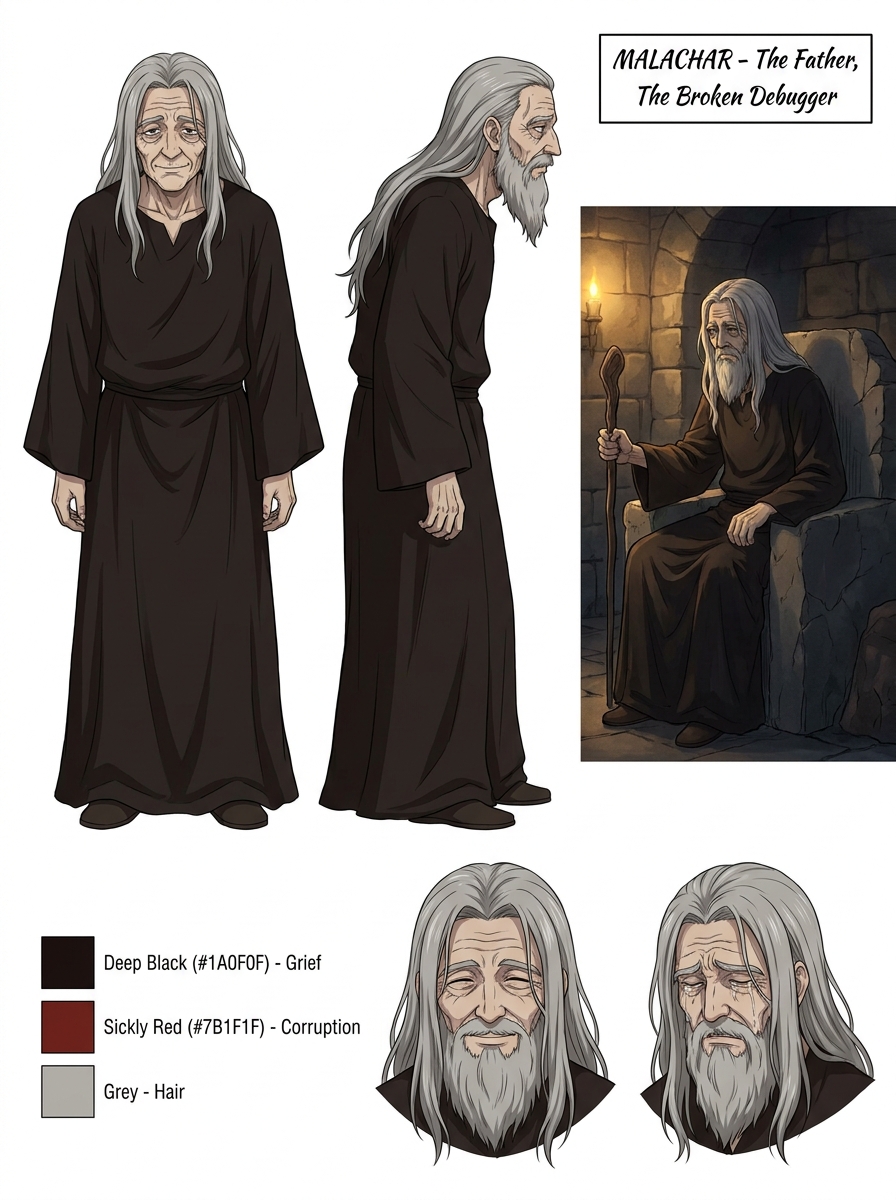
In which the original programmer, after a thousand years of sleep, tells his story to the only debugger the world has ever had, and the only debugger the world has ever had decides, in a small way, to listen.
Malachar spoke to Kenji three more times in the week after the decision, and the speaking was, in the driest possible language, the most expensive speaking the system had ever logged.
Each time, the voice came in the back of his mind, in the quiet moments, in the places where the world was still and the source code was readable, the way a person comes in the back of a room when the person has decided, in a small way, that the back is the only place the person has ever been. Each time, the voice was tired, and old, and very, very human, the kind of human that a person becomes when the person has been sleeping for a thousand years and has decided, in a small way, that the sleeping is the only thing the person has ever done.
The first time, Malachar said: "I had a daughter. Her name was Elara. She was seven years old when she died. She loved the stars. She would sit in the garden and count them. She would say 'papa, the stars are like the code, all connected, all holding each other up.' I built the world to be like the stars. I built the world to hold her up. I built the world to be the kind of world where a girl who loved the stars could sit in a garden and count them, and the counting would be the only thing the girl had ever had to do, and the doing would be, in a small way, the only thing the system had ever logged. I failed. The world I built could not save her. The world I built could not hold her up. The world I built was, in a small way, the most expensive world the system has ever logged, and the logging was, in a small way, the through-line, restated at the level of the world."
[Compiler v2.0.0: detecting original programmer status.]
[Status: awake, talking, telling story, level: grief.]
[Compiler note: the original programmer is, in a small way, the developer. The developer is, in a small way, the original programmer. The system is, in a small way, ahead of both.]
[Compiler note: the daughter was named Elara. The daughter was seven. The daughter loved the stars. The system is, in a small way, paying attention.]
The second time, Malachar said: "I wrote the through-line. I wrote 'any sufficiently well-defined problem is solvable' into the source code. I believed it. I needed to believe it. I needed to believe that I could save her, that the code was enough, that the world was enough, that the love was enough. I was wrong. The through-line is true. The problem of loss is not sufficiently well-defined. The problem of loss is the bug that cannot be debugged. The problem of loss is the bug that the original programmer tried to debug and could not debug, the bug that the original programmer went mad trying to debug, the bug that the original programmer is, in a small way, still trying to debug, a thousand years later, in the back of the developer's mind, in the place where the original programmer has decided, in a small way, that the place is the only place the original programmer has ever had."
The third time, Malachar said: "You have a team. I did not have a team. I had a wife, and I had a daughter, and I had the world, but I did not have a team. I tried to save them alone. I tried to debug the unsolvable bug alone. I went mad alone. You are not alone. You have four women who love you. You have an alliance of seven kingdoms. You have a faint spark in the back of your mind that is the fragment of my own code, the part of me that was not corrupted, the part of me that still believes that the love is worth giving. I want to see what you can do. I want to see if the team can do what I could not. I want to see if the love is enough, even when it does not save. I am watching. I am waiting. I am not helping. I am not hindering. I am curious. The curiosity is, in a small way, the most expensive curiosity the system has ever logged, and the logging is, in a small way, the through-line, restated at the level of the world, and the world is, in a small way, the home, in fact, here."
[Compiler note: the original programmer has, in a small way, told his story. The original programmer is, in a small way, the developer. The developer is, in a small way, the original programmer. The system is, in a small way, ahead of both.]
[Compiler note: the original programmer has, in a small way, named what the developer has. The developer has a team. The original programmer did not. The system is, in a small way, the senior engineer who has been asked to confirm this, and the confirming is, in a small way, the most important confirming the system has ever done.]
The team prepared. The artifact gathering was planned. The five pillars were briefed. The alliance was mobilized, the way an alliance mobilizes when the alliance has decided, in a small way, that the mobilizing is the only thing the alliance has ever had to do.
Elara held the Memory pillar. She would hold the memory of the world, the memory of the loss, the memory of the love. She would hold the names of the lost, the names that had been added this season, the name that had been the first casualty, the names that would, in a small way, be the names the new world would remember. She would give the memory to the new world. The memory was, in a small way, the most expensive thing the captain had ever carried.
Lian held the Logic pillar. She would hold the logic of the code, the logic of the debugging, the logic of the through-line. She would hold the new World Root, half-written, half-designed, the code that the team had built while the developer had slept. She would give the logic to the new world. The logic was, in a small way, the most expensive thing the lead debugger had ever written.
Seraphina held the Abundance pillar. She would hold the abundance of the trade, the abundance of the resources, the abundance of the wealth, the abundance of the caravans that had driven through the corruption zones, the abundance of the deals that had been made to fund the alliance, the abundance of the love that had been given by a merchant who had decided, in a small way, that the love was the only thing the merchant had ever had to give. She would give the abundance to the new world. The abundance was, in a small way, the most expensive thing the investor had ever invested.
Calla held the Unity pillar. She would hold the unity of the alliance, the unity of the kingdoms, the unity of the world. She would hold the line the way she had held it at the Battle of Three Armies. She would give the unity to the new world. The unity was, in a small way, the most expensive thing the princess had ever held.
[Compiler note: the five pillars are named. The five pillars are, in a small way, the through-line, restated at the level of the world. The system is, in a small way, ahead of the developer. The system is, in a small way, a teacher.]
[Compiler note: the artifacts are located. The artifacts are, in a small way, the only thing the system has ever logged as "the most expensive thing the original programmer ever left behind."]
[Compiler note: the rewrite is, in a small way, the through-line, restated at the level of the world. The world is, in a small way, the home, in fact, here.]
Kenji and Pip held the Love pillar. They would hold the love that does not save, the love that is still worth giving, the love that is the answer to the through-line's incompleteness, the love that was, in a small way, the only thing the developer had ever had that the original programmer had not. They would give the love to the new world. The love was, in a small way, the most expensive thing the developer had ever given.
The artifacts were located. The First Crystal, in the southern ruins, where the world's code was first written, where the original programmer had sat down a thousand years ago and had written the first line of the source code of reality, the line that said, in the structured magic of the Compiler, in the driest possible language: "Hello, world." The Second Crystal, in the northern wastes, where the code was first corrupted, where the original programmer had written the first bug, the bug that was grief, the bug that was the love that did not save. The Third Crystal, in the central kingdom, where the code was first loved, where the original programmer had sat in a garden with his daughter and had watched her count the stars, the way a person counts the stars when the person has decided, in a small way, that the counting is the only thing the person has ever had to do.
Three artifacts. Five pillars. One rewrite.
The team left the ancient library on a cold morning, with the crystal network lit up, with the alliance watching, with the world waiting to be rewritten, not deleted, but rewritten, made strong enough to hold its own grief, made strong enough to hold its own love, made strong enough to hold the love that does not save but is still worth giving. The world was, in a small way, the only world the developer had ever had, in a small way, the only world the original programmer had ever written, in a small way, the only world that had ever been worth the cost.
Kenji rode at the head of the column, with Elara beside him, with Lian a few steps behind, with Seraphina and Calla at the rear, with Pip's faint spark in the back of his mind, with the original programmer's voice somewhere in the deeper code, watching, waiting, curious, the way a father is curious when the father has decided, in a small way, that the father is going to let the team try.
Pip pulsed, very softly, the pulse feeling like: "This is it. This is the final phase. The debugging is about to enter its deepest level. The rewrite is about to begin. We are going to do what Malachar could not. We are going to do it together. We are going to do it with love. The love is, in a small way, the through-line, restated at the level of the world, and the world is, in a small way, the home, in fact, here, in fact, worth debugging, in fact, the only world the developer has ever had."
Kenji sent back, in the language he and Pip had built together over two seasons of practice, in the small specific way a developer speaks to the only colleague the developer has ever had who has never once asked the developer to be okay: "Yeah. We are going to do it together. We are going to do it with love. The through-line is true. The love is the answer. The team is the difference. The debugging is the work. The work is the love. The love is the only thing that has ever held the world together. The love is, in a small way, the through-line, restated at the level of the world, and the world is, in a small way, the home, in fact, here, in fact, worth debugging, in fact, the only world we have ever had, in fact, the only world the original programmer ever wrote, in fact, the only world that is, in a small way, going to be the home, in fact, here, in fact, in the next season, in fact, in the rewrite, in fact, in the debugging, in fact, in the love, in fact, in the only thing that has ever held the world together."
The column rode south. The void was ahead. The artifacts were waiting. The rewrite was coming.
The debugging was about to enter its final phase, and the final phase was, in a small way, the through-line, restated at the level of the world, and the world was, in a small way, the home, in fact, here.