Kenji's Breakdown
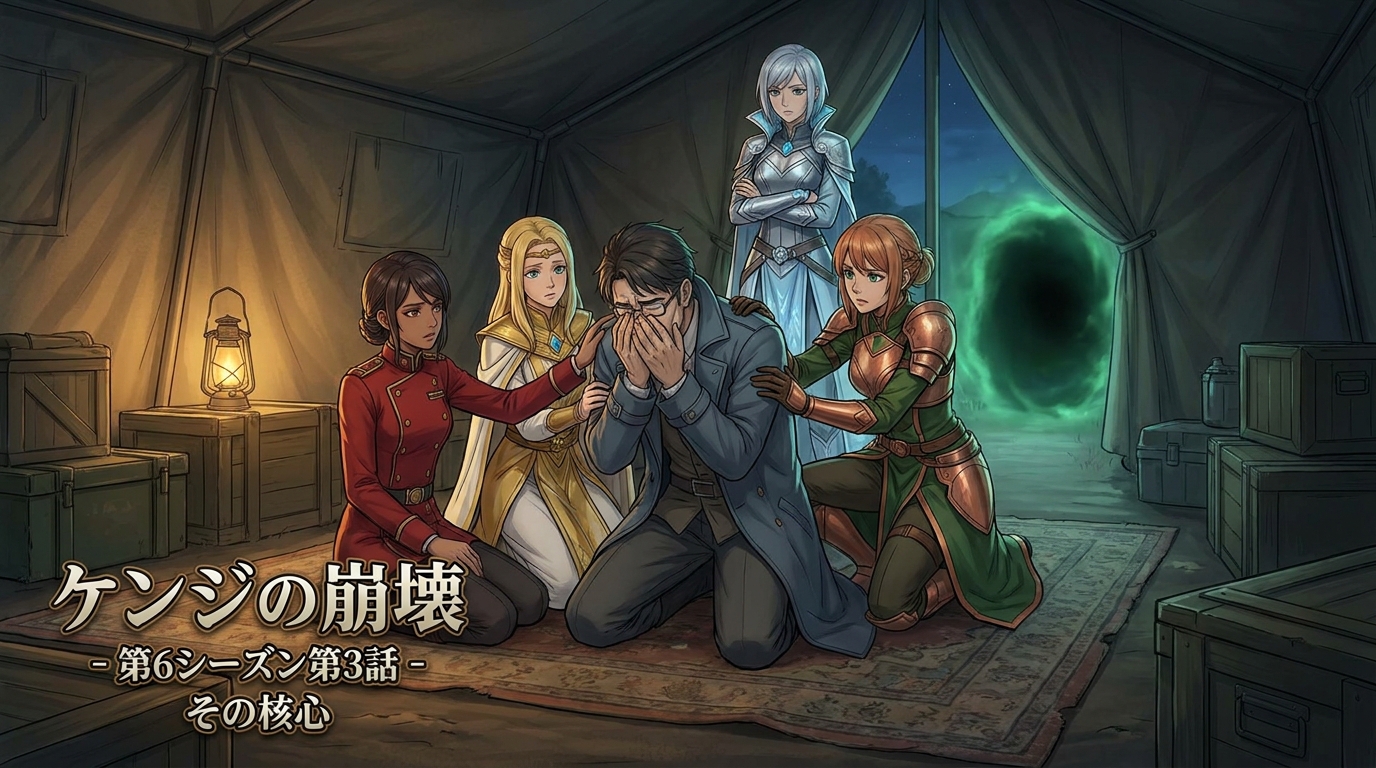
In which our protagonist stops, the systems that have been holding him up stop with him, and four people sit with him in the dirt while the world, in a small way, waits.
The breakdown came on a Sunday, which was, in the small specific way a person who has been keeping Sundays since the first season understands, the kind of detail the system would have logged if the system had been the kind of system that cared about days, and the system was, in a small way, the kind of system that cared about days, and the caring was, in a small way, the most important thing the system had ever done.
It was not a dramatic breakdown. It was not the kind of breakdown that gets written down in reports, the kind of breakdown that has a timestamp and a cause and a resolution. It was the kind of breakdown where a person just stops. Where the focus stops. Where the determination stops. Where the through-line, the through-line that had been his spine since the clock tower in Oakhaven, stops being true for a few hours, and the person is left standing in the silence, in the dirt, in the south, at the edge of the void, holding a notebook full of words that would not compile.
[Compiler v2.0.0: detecting focus degradation.]
[Composition: developer has not slept in 4 days. Developer has not eaten in 2.]
[Recommended action: stop. Rest. Let the team carry the world for a while.]
[Compiler note: the developer is, in a small way, the system that needs debugging.]
He was in the field chair, the one he had brought south, the one that had become, over the course of three days, less a chair and more a confession booth. The notebook was open on his knee. The notebook was full of pseudocode, of spell definitions, of the careful handwriting of a man who had been writing down the world's source code for two seasons. The notebook was, in a small way, the most honest thing he owned. The notebook was, in a small way, the only place where the words had been allowed to be wrong.
The words were wrong. The pseudocode would not compile. The new World Root, the source code for a world that could hold its own loss, would not take shape on the page. He had been trying to write it for three days. He had been trying to write it for three days, and the words were not coming, and the not-coming was, in the small specific way a person who has been a software engineer for ten years recognizes, the kind of error that is not in the code.
The error was in the developer.
Pip's faint spark pulsed, very softly, in the back of his mind, the pulse feeling like: "You are not alone. You are not the only one. You do not have to carry this by yourself. The chair is not the answer. The team is the answer. The team has been the answer since the first season."
[Compiler note: developer is at 4% focus. Developer is at 0% energy. Developer is, in a small way, the kind of developer who has been asked to debug the world and has decided, in a small way, that the world is too much to debug alone.]
[Compiler note: this is not a failure. This is the cost. The system is, in a small way, paying attention.]
"I have to carry this," he said, out loud, to the chair, to the notebook, to the void on the southern horizon. "I am the senior partner. I am the architect. I am the one who debugs the world. I am the one who holds the line. I am the one who does not break."
The spark pulsed again. The pulse felt like: "You are a person. Persons break. That is what persons do. You have been carrying the world for two seasons. You have been carrying the through-line. You have been carrying the alliance. You have been carrying the team. You have been carrying the cost. Maren. The refugees. The void. The corruption. You have been carrying it all, and you have not been letting anyone help you carry it, and the not-letting is, in a small way, the most expensive thing the system has ever logged."
"I cannot let anyone help. I am the only one who can do this. I am the only one who knows the source code. I am the only one who can rewrite the World Root."
"That is not true," Pip said, and the saying was, in a small way, the most important thing Pip had said since the absorption at the climate thermostat. "Lian can read the source code. Elara can hold the line. Seraphina can fund the work. Calla can lead the army. The team can do this without you. You do not have to carry it alone."
"Yes I do."
"No. You do not. You are a debugger. You debug systems. You do not debug yourself. You are not the debugger. You are the system that needs debugging. You are the bug."
[Compiler note: this is the through-line, restated at the level of the developer. The developer is the bug. The team is the debugger. The cost is real. The system is, in a small way, ahead of the developer.]
[Compiler note: the developer is, in a small way, learning. The learning hurts. The system is, in a small way, the kind of teacher who lets the student learn by falling down.]
He put the notebook down. He put his head in his hands. He did not cry. He was not, in the small specific way a person who has been keeping himself together for two seasons is, the kind of person who cried in front of people. He was the kind of person who cried later, alone, in the dark, after the reports had come in and the team had gone to bed and the chair had become the only honest thing in the world. He was that kind of person. He had been that kind of person since the first season, since the clock tower, since the first time he had told a team of skeptical engineers that the water could be made to come back. He was, in a small way, the same person he had been in Tokyo, the same person who had sat at his desk and read the dashboards and not cried, the same person who had been paged at 3 AM and not cried, the same person who had watched the world be a worse place for his absence than his presence and not cried.
He was that kind of person. He was that kind of person, and the kind of person was, in a small way, the bug.
Then Elara came.
She did not say anything. She did not ask. She did not bring a report. She did not bring a status update. She brought herself. She sat down beside him, in the dirt, in the cold, in the south, at the edge of the void. She put her hand on his shoulder. She did not tell him it would be okay. She did not tell him to be strong. She did not tell him to debug. She just sat, and held him, and let him break.
Then Lian came. She sat on his other side, with her notebook closed, with her eyes tired, with the look of a person who had been reading the source code for weeks and had decided, in a small way, that the source code could wait. She did not write. She just sat.
Then Calla came. She brought tea. She had gone back to the camp, and she had made tea, the way a princess who had given up a kingdom made tea when the world was being deleted, with the same steady hands, with the same quiet care, with the same kind of love that did not save but was still worth giving. She set the cup down beside him, and she sat, and she did not say anything.
Then Seraphina came. She had been in the south, running the Silver Road, getting people out, but she had heard. She came in dusty, tired, with the merchant's ledger under her arm, with the look of a person who had been investing in this world for two seasons and was not, in a small way, going to stop investing now. She sat down. She did not say anything.
The four of them sat with him, in the cold, in the dirt, at the edge of the void, and they did not tell him to be strong. They did not tell him to debug. They did not tell him that the through-line was true. They did not tell him that the cost was worth it. They did not tell him that Maren would have wanted him to keep going. They just sat with him, and held him, and let him break, and the letting was, in a small way, the most important debugging the team had ever done.
He broke. He let himself break. He let the weight of everything he had been carrying come down on him, and he did not try to hold it up. He let the team hold it up. He let the debugging partnership become what it had always been, what it had been since the first season, since the clock tower, since the first time he had sat on a wall at midnight with Elara and talked about fear. A team. A family. A group of people who held the world together because they held each other together.
[Compiler note: the developer is, in a small way, allowing himself to be debugged. This is the hardest commit the developer has ever made. The system is, in a small way, proud of him.]
[Compiler note: the team is the debugger. The team is, in a small way, the senior engineer who has been asked to onboard a junior to the cost, and the senior engineer is, in a small way, the kind of senior engineer who knows that the cost is paid in people, and the people are, in a small way, the only thing that has ever been worth paying for.]
The breakdown lasted an hour. When it was over, he was still tired. He was still sad. He was still carrying the cost. But he was not carrying it alone. He was, in the small specific way a person who has been debugging for ten years recognizes, the kind of developer who had finally let the team debug, and the letting was, in a small way, the most important commit he had ever pushed.
Pip's faint spark pulsed, very softly, in the back of his mind, the pulse feeling like: "This is what I wanted for you. This is what the system was for. A debugger who lets the team debug. A senior partner who lets the junior partners help. A person who lets the people who love him hold him. The cost is the same. The love is the same. The debugging is the same. The through-line is, in a small way, true, but the through-line has always needed the team, and the team has, in a small way, always been the only thing that has ever held the world together."
Kenji did not say anything. He did not have to say anything. He just sat, in the dirt, with the four of them, with the faint spark, with the void on the southern horizon, and the weight was shared now, and the sharing was, in a small way, the only debugging that had ever mattered.