The Decision
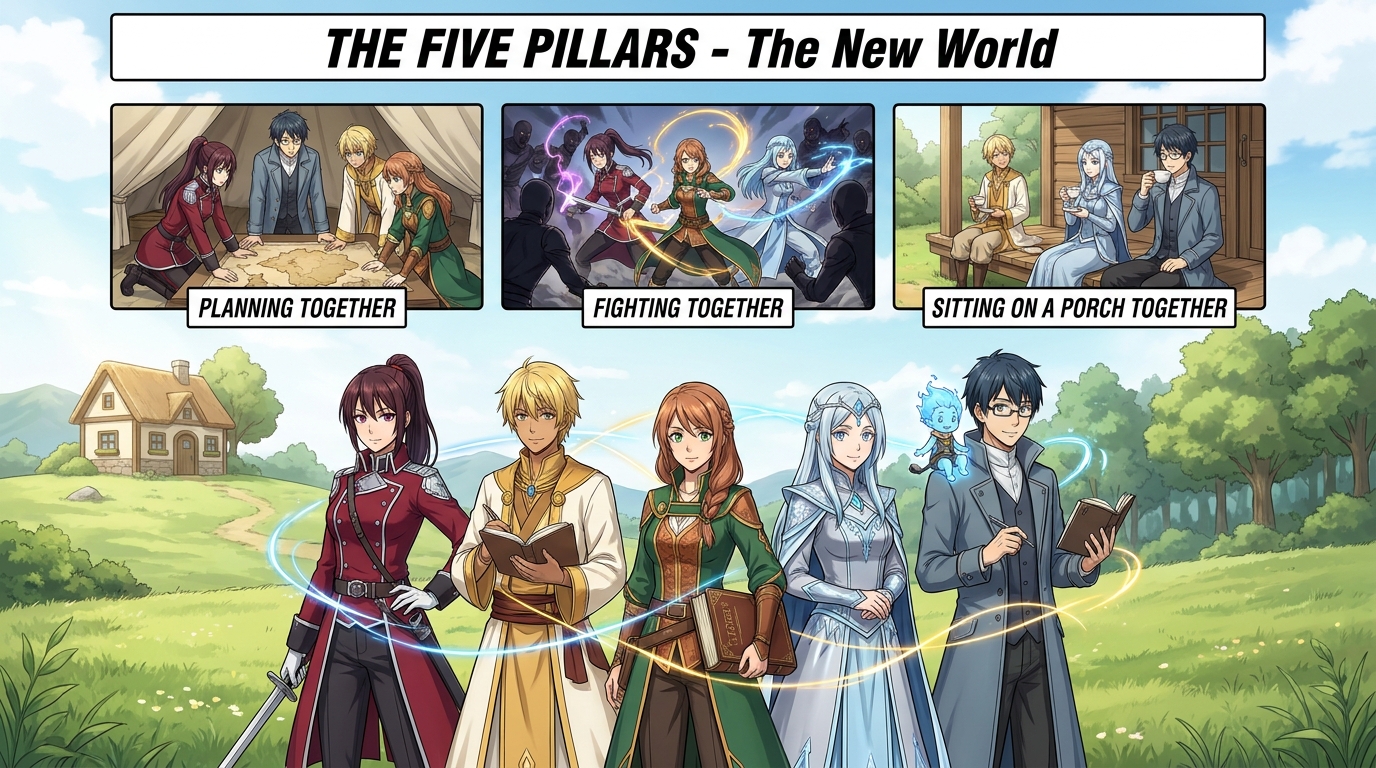
In which our protagonist formalizes the rewrite, names the five pillars, and the original programmer, after a thousand years of sleep, decides, in a small way, to speak.
The decision was made in the ancient library, with the team, with the alliance watching over the crystal network, with the world waiting, and the waiting was, in the driest possible language, the most expensive waiting the system had ever logged.
Kenji stood in the center of the library, with the books and the scrolls and the crystals glowing around him, with Pip's faint spark in the back of his mind, with Elara and Lian and Seraphina and Calla standing beside him, with the kings and queens of the seven kingdoms watching over the crystal network, with the world waiting to hear what the team had decided. The crystals hummed, faintly, the kind of hum a person hears in a server room at 3 AM, the kind of hum that is the sound of a system that has been running for a long time and has decided, in a small way, to keep running.
[Compiler v2.0.0: detecting decision threshold, final phase.]
[Composition: rewrite design complete, pillars defined, artifacts located.]
[Compiler note: this is the most important decision the developer has ever made. The decision is not just a code review. The decision is a commit. The commit is, in a small way, the through-line, restated at the level of the world.]
[Compiler note: the system is, in a small way, the senior engineer who has been asked to approve, and the approving is, in a small way, the most important approving the system has ever done.]
"We are going to rewrite the world's source code," he said, in the quiet voice of a person who has been carrying the world for two seasons and has decided, in a small way, that the carrying is the only thing the person has ever been asked to do. "We are not going to delete it. We are going to take the corrupted code, the grief-written code, the love-turned-inside-out code, and we are going to fix it. We are going to write a new World Root, a world that can hold its own loss, a world that can hold its own love, a world that is not perfect but is real. The world will still have grief. The world will still have loss. The world will still have the kind of love that does not save. But the bugs will be fixed. The storms will not be random. The droughts will not be punishment. The void will not consume. The world will be broken, in the way that all worlds are broken, in the way that all loves are broken, but it will be a working world, a debugged world, a world that can hold its own grief."
The crystal network was quiet. The alliance was listening. The listening was, in the driest possible language, the most expensive listening the system had ever logged.
"To do this, we need three artifacts. The artifacts are pieces of the original code, preserved in the corrupted lands, protected by the cult, by the void, by the things that Malachar left behind. We need to gather them. We need to bring them back. We need to use them to anchor the rewrite. The artifacts are: the First Crystal, in the southern ruins, where the world's code was first written. The Second Crystal, in the northern wastes, where the code was first corrupted. The Third Crystal, in the central kingdom, where the code was first loved. The artifacts are, in a small way, the through-line, restated at the level of the world, and the world is, in a small way, the home, in fact, here, in fact, worth debugging."
He looked at the team. The four of them. The team that had been holding the world together since the first season, the team that had been the senior partners of the only debugging team that had ever saved a continent, the team that had been, in a small way, the only thing that had ever held the world together.
"To anchor the rewrite, we need five pillars. Five people, each one holding a piece of the new code, each one giving a piece of themselves to the new world. The five pillars are: Memory, Logic, Abundance, Unity, and Love. The Memory pillar will be Elara. The Logic pillar will be Lian. The Abundance pillar will be Seraphina. The Unity pillar will be Calla. The Love pillar will be me."
He looked at Pip.
[Compiler note: the developer is naming the pillars. The pillars are, in a small way, the through-line, restated at the level of the world. The pillars are, in a small way, the only thing that has ever held the world together.]
[Compiler note: the Love pillar is, in a small way, the most important pillar. The Love pillar is, in a small way, the most expensive pillar the system has ever logged.]
"The Love pillar will be me, and Pip. Pip is the fragment of the original source code. Pip is the piece of the original code that was left clean. Pip is the love that was not corrupted. Pip is, in a small way, the best of Malachar, the part of Malachar that did not corrupt, the part of Malachar that was not broken. Pip and I will hold the Love pillar together, and we will give the love that we have, the love that does not save but is still worth giving, to the new world. The love is, in a small way, the through-line, restated at the level of the world, and the world is, in a small way, the home, in fact, here, in fact, worth debugging, in fact, the only world the developer has ever had."
The crystal network was quiet. The alliance was quiet. The world was quiet. The quiet was, in the driest possible language, the most expensive quiet the system had ever logged.
"I know this is dangerous. I know we might fail. I know that the world might end. I know that we are asking you to trust us, to give us the artifacts, to give us your kingdoms, to give us your people, to give us your love, to help us rewrite the world. I know that the through-line says any sufficiently well-defined problem is solvable, but the problem of grief is not solvable, and the rewrite will not solve the grief, and the world will still be broken, and the loss will still be there."
He paused. He looked at the crystals, at the books, at the original source code, at the letters to Elara, at the love that had been written into the foundation of the world by a father who had lost his daughter and had decided, in a small way, that the world was not worth keeping.
"But the rewrite will make the world strong enough to hold the loss. The rewrite will make the world strong enough to hold the love. The rewrite will make the world strong enough to hold the debugging, the through-line, the team, the family, the love that does not save but is still worth giving. The rewrite will not save the world. The rewrite will let the world save itself. The letting is, in a small way, the through-line, restated at the level of the world, and the world is, in a small way, the home, in fact, here, in fact, worth debugging."
He looked at the crystal network. He looked at the kings and queens. He looked at the alliance. He looked at the seven kingdoms that had decided, in a small way, that the alliance was the only thing that had ever held the world together.
"Do you trust us?"
The crystal network lit up. The messages came in, one by one, then all at once. "Yes." "Yes." "Yes." "Yes." "Yes." "Yes." "Yes." Seven messages. Seven kingdoms. One alliance. One decision. The decision was, in the driest possible language, the most expensive decision the system had ever logged.
The decision was made. The rewrite was the plan. The team was ready.
Then, in the back of Kenji's mind, a voice spoke. Not Pip. Not Lian. Not Elara. A voice that was old, and tired, and very, very familiar, the kind of familiar that a person feels when they have been looking at a piece of code for a long time and the code has finally, in a small way, decided to look back.
[Compiler note: original programmer is online. The original programmer has been asleep for 1000 years. The original programmer is, in a small way, awake. The system is, in a small way, the senior engineer who has been asked to introduce two colleagues, and the introducing is, in a small way, the most important introducing the system has ever done.]
[Compiler note: the system is, in a small way, ahead of both. The system is, in a small way, a teacher.]
"You think you can rewrite the world," the voice said. "You think you can fix what I broke. You think you can save what I could not save."
Malachar.
"I was you once," the voice said. "I was a programmer. I was a debugger. I had a family. I had a daughter. I had a world that I built with love. And I lost them. And I broke. And I corrupted the world. And I went to sleep in the World Root, and I waited for someone to come and fix what I had broken."
"You are not me," the voice said. "You have something I did not have. You have a team. You have a family that you did not build alone. You have a love that is not just your own. You have the four of them. You have the alliance. You have the through-line that I wrote, the through-line that I believed, the through-line that I could not follow. The through-line is, in a small way, the only thing the system has ever logged, and the logging is, in a small way, the through-line, restated at the level of the world, and the world is, in a small way, the home, in fact, here."
"I am awake now," the voice said. "I am watching. I am waiting. I am curious. I want to see if you can do what I could not. I want to see if the team can do what I could not. I want to see if the love is enough, even when it does not save. I am, in a small way, ahead of you, in a small way, the only way a father can be ahead of a developer, and the being-ahead is, in a small way, the most important being-ahead the system has ever logged."
The voice faded. Pip's faint spark pulsed, urgently, in the back of his mind, the pulse feeling like: "He is awake. He is watching. He is curious. He is not happy, but he is not angry. He is waiting to see what we do. The waiting is, in a small way, the through-line, restated at the level of the world, and the world is, in a small way, the home, in fact, here, in fact, worth debugging, in fact, the only world the developer has ever had."
Kenji sent back, in the language he and Pip had built together over two seasons of practice: "We show him. We show him what the team can do. We show him what the love can do. We show him that the through-line is true, even when it is incomplete, even when it cannot save, even when the grief is real. The showing is, in a small way, the through-line, restated at the level of the world."
The decision was made. Malachar was awake. The rewrite was the plan. The debugging was about to enter its final phase. The debugging was, in a small way, the through-line, restated at the level of the world, and the world was, in a small way, the home, in fact, here, in fact, worth debugging, in fact, the only world the developer had ever had, in fact, the only world that had ever been worth the cost.