The Corrupted Code
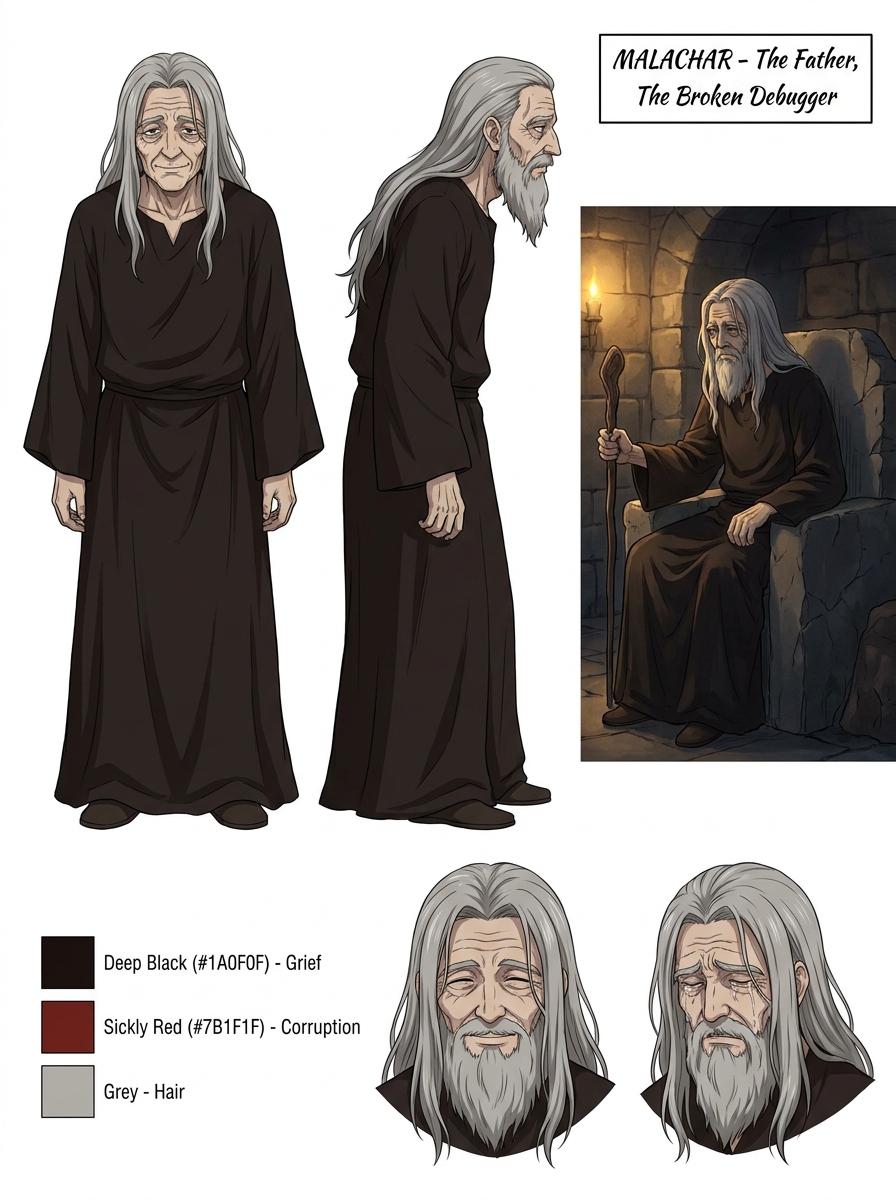
In which our protagonist sees the full extent of the damage, and learns that the world's code is not just buggy, it is grieving.
Lian read the corrupted code to them, in the ancient library, over the course of three days. She read it slowly, carefully, with the same precision she had used to design the new World Root. She read it the way a doctor reads a diagnosis, the way a debugger reads a stack trace, the way a person reads a letter from someone they have lost.
The code was beautiful. That was the first thing Kenji noticed. The world's original source code, the code that Malachar had written before he had corrupted it, was beautiful. It was elegant, it was careful, it was the work of a person who had loved the world and had wanted to build something that would last. The code was full of comments, full of explanations, full of the small kindnesses that a programmer leaves for the next person who has to read the code.
The code was also full of grief.
Lian read the comments. They were not in any human language. They were in the structured magic of the Compiler, in the kind of code that Kenji used every day. But they were not debug logs. They were not technical notes. They were letters. They were letters from Malachar to his daughter, written into the source code of the world, hidden in the foundation, where no one would ever read them.
For Elara, who loved the stars.
For Elara, who asked why the moon changes shape.
For Elara, who said "the world is beautiful, papa."
For Elara, who is gone.
Elara Vance, who was sitting beside Kenji, made a small sound when Lian read the name. She had not known. She had not known that the world's code was named after her, in a way, by a father who had loved a daughter who had shared her name.
The corruption was in the code the way grief is in a person. It was not a single bug. It was not a single error. It was a thousand small changes, each one a moment of pain, each one a memory of loss, each one a piece of the world being broken because the world had not been enough to save the people he loved.
There was a corruption in the weather system, a piece of code that was supposed to make the rain gentle but instead made it violent. The comment read: "The rain is not gentle. The rain is grief. I am sorry, Elara."
There was a corruption in the growth system, a piece of code that was supposed to make the crops grow but instead made them wilt. The comment read: "I tried to make the world fertile. I tried to make it give life. I failed. I am sorry, Elara."
There was a corruption in the healing system, a piece of code that was supposed to cure sickness but instead spread it. The comment read: "I tried to make the world heal. I tried to make it cure. I could not cure her. I am sorry, Elara."
Lian read the comments, and the room was silent, and the corruption was not just code. The corruption was grief. The corruption was a father's love, turned inside out by loss, written into the foundation of the world, where it had been running for a thousand years, breaking everything, because the father could not stop breaking things.
Kenji listened. He did not say anything. He thought about the through-line. He thought about the fact that the through-line was true, that any sufficiently well-defined problem was solvable, but that the problem of grief was not sufficiently well-defined. The problem of grief was the problem of loss, the problem of death, the problem of the thing that no code can fix, the problem that Malachar had tried to fix and had failed and had gone mad trying to fix.
Pip's faint spark pulsed, in the back of his mind, very softly, the pulse feeling like: "This is the truth. This is the corruption. This is what we have been debugging. We have been debugging a father's grief. We have been debugging a love that turned to madness. We have been debugging the through-line, written by a man who could not follow it."
Kenji sent back: "What do we do?"
"We do what the through-line cannot. We do what the code cannot. We do what the love, the real love, the love that is not a system, can do. We listen. We understand. We do not delete. We do not rewrite. We do not fix. We accept. We accept the grief. We accept the loss. We accept that some bugs cannot be fixed. We accept that the only thing we can do is be with the people who are broken, and hold them, and let them break, and not try to make them unbroken."
"That is not debugging."
"That is the deepest debugging. That is the debugging that the original programmer could not do. That is the debugging that requires a team, that requires a family, that requires the love that the love, when it is real, when it is not just a system, can give."
Kenji looked at Lian. He looked at Elara, who was crying quietly, who had just learned that the world's grief was named after her, in a way, by a father who had loved a daughter who had shared her name. He looked at Calla, who was holding Elara's hand. He looked at the books, at the scrolls, at the crystals, at the code that was beautiful and broken and grieving.
"Okay," he said. "We accept. We do not fix. We do not delete. We rewrite. We rewrite the world's code, not to delete the grief, but to accept the grief, to make the world a place where grief can exist, where loss can be held, where the love that does not save the people we love can still be the love that holds the world together."
"That is the rewrite," Lian said. "That is the new World Root. Not a world without loss. A world that can hold loss. A world that is not corrupted by grief, but that is strengthened by it. A world that does not pretend that love can save everyone, but that knows that love is still worth giving, even when it cannot save."
He thought about the through-line. He thought about the fact that it was still true. Any sufficiently well-defined problem is solvable. The problem of grief is not solvable. The problem of loss is not solvable. But the problem of how to live in a world where grief exists, that is solvable. That is what the new World Root will be.
# WORLD.md (updated)

## Status
- The corrupted code: read, understood, not just bugs, but grief
- Malachar's letters: to his daughter Elara, hidden in the source code
- The new World Root: not a world without loss, a world that can hold loss
- The team: has the truth, has the rewrite, has the love

## Lessons
- The corruption is grief. A father's love, turned inside out by loss.
- The through-line is true, but it does not solve grief. It never did.
- The deepest debugging is not fixing. It is accepting. It is being with.
- The new World Root: a world that can hold loss, not a world without loss