The Impossible Choice
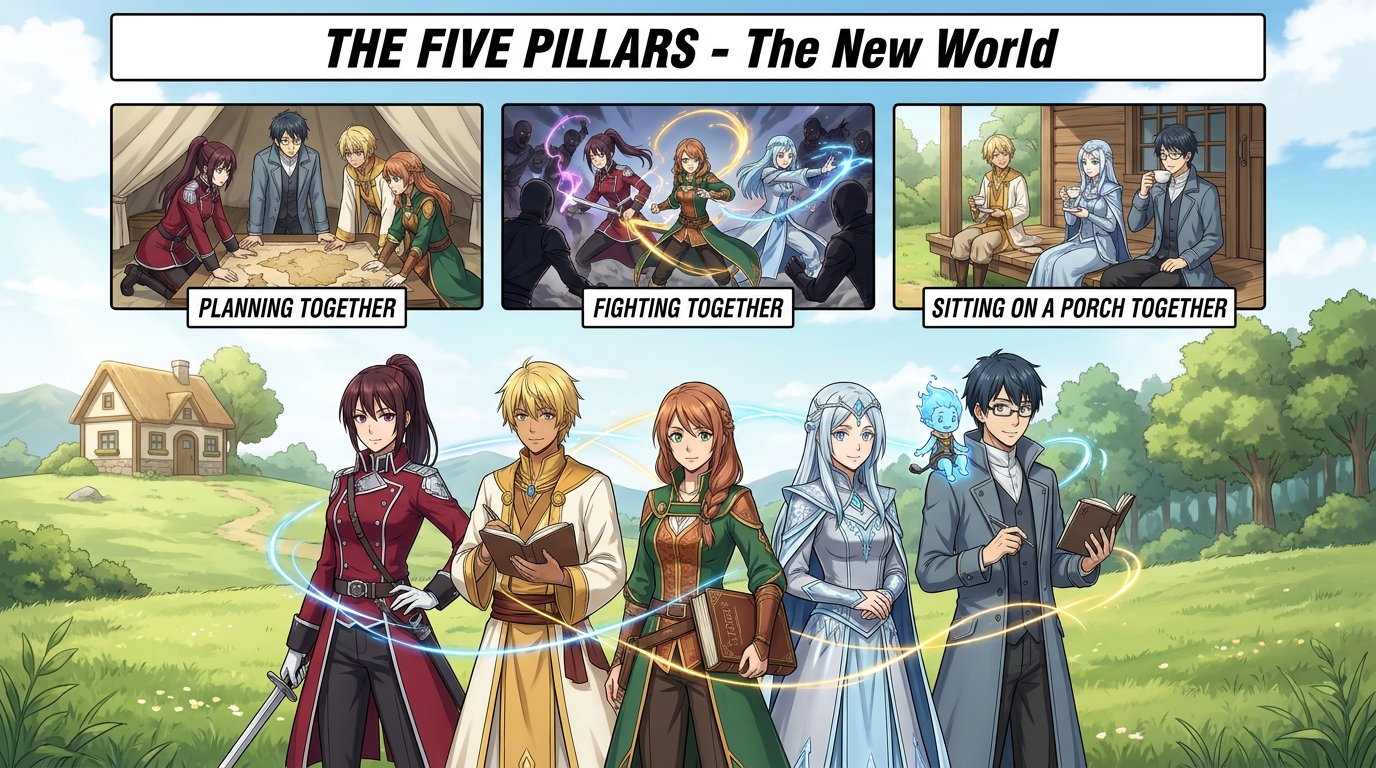
In which our protagonist faces the central moral question of the series, and discovers that the choice is not between two options, but between two ways of loving.
The choice was clear, and the choice was impossible.
The team had the new World Root, half-written, half-designed, the code for a world that could hold loss. They had the source code of the old world, the corrupted source code, the grief-written code that was running the world now. They had the World Root itself, the place where the world's code was generated, the place where the rewrite would happen.
They had two options.
Option one: delete the corrupted source code. Delete the grief. Delete the corruption. Delete the world as it was, and start over. The new world would be clean, would be bug-free, would be a world without loss, without grief, without the kind of love that does not save. The void was already doing this, eating the world from the south, deleting the code as it went. If they helped the void, if they let it consume the World Root, the world would be deleted, and a new world could be written from scratch, by the team, by the alliance, by the debugging partnership. The new world would be perfect. The new world would be lossless. The new world would not have the kind of love that Malachar had, the kind of love that breaks when it loses.
Option two: rewrite the source code. Keep the world. Keep the grief. Keep the loss. But fix the corruption, the bugs that Malachar had written, the parts of the code that were breaking the world. The new world would still have loss. The new world would still have grief. The new world would still have the kind of love that does not save. But the bugs would be fixed. The storms would not be random. The droughts would not be punishment. The void would not consume. The world would be broken, in the way that all worlds are broken, in the way that all loves are broken, but it would be a working world, a debugged world, a world that could hold its own grief.
Option one was easier. Option one was cleaner. Option one was the world that Malachar had wanted to build, the world without loss, the world that would have saved his daughter if he had built it in time.
Option two was harder. Option two was messier. Option two was the world that Kenji had, the world that had lost people, the world that had paid the cost, the world that had Maren, the world that had the refugees, the world that had the void. Option two was the world that was worth saving, not because it was perfect, but because it was real.
The team sat around the table, in the ancient library, and they argued.
Elara said: "We should rewrite. We should not delete. Deleting is what the void does. Deleting is what Malachar wanted. We are not Malachar. We are the team. We hold the world. We do not delete it."
Lian said: "I have run the numbers. The rewrite is possible. It will take three artifacts, scattered across the corrupted lands. It will take the five pillars, five people holding the rewrite, each one giving a piece of themselves to the new world. It will take Kenji, at the center, writing the new code. It is possible. It is also dangerous. If we fail, the world ends."
Seraphina said: "I will fund it. Whatever it costs. I have been investing in this world for two seasons. I am not going to delete my investment."
Calla said: "I will lead the artifact gathering. I have held the line before. I will hold it again. The northern kingdom will provide the army, the mages, the supplies. We will not delete. We will rewrite."
They all looked at Kenji.
"What do you think?" Elara asked.
He sat in the chair. He thought about the through-line. He thought about the fact that any sufficiently well-defined problem is solvable, but that the problem of grief was not solvable. He thought about Malachar, the father, the programmer, the man who had tried to solve the unsolvable problem and had gone mad trying. He thought about his own family, the family he had built, the family that was sitting around the table, the family that was about to decide the fate of the world.
"I think," he said, slowly, "that the through-line is true. But I also think the through-line is incomplete. The through-line says: any sufficiently well-defined problem is solvable. The problem of grief is not sufficiently well-defined. The problem of loss is not solvable. The problem of the love that does not save is not solvable."
"So we delete?" Lian asked.
"No. We rewrite. We do not delete, because deletion is what the void does. We do not delete, because deletion is what Malachar wanted. We do not delete, because the world is worth keeping, even with its grief, even with its loss, even with the kind of love that does not save."
"We rewrite," Elara said.
"We rewrite," Lian said.
"We rewrite," Seraphina said.
"We rewrite," Calla said.
Pip's faint spark pulsed, in the back of his mind, very softly, the pulse feeling like: "Yes. We rewrite. We do not delete the grief. We do not delete the loss. We make the world strong enough to hold them."
Kenji sent back: "Yeah. We make the world strong enough to hold them."
The choice was made. The impossible choice was resolved. The team chose to rewrite, not delete. The team chose to keep the world, with its grief, with its loss, with the kind of love that does not save.
The debugging was about to enter its final phase.
# WORLD.md (updated)

## Status
- The choice: rewrite, not delete
- The new World Root: a world that can hold loss
- The artifacts: three needed, scattered across the corrupted lands
- The five pillars: needed for the rewrite
- The team: committed, ready

## Lessons
- "Deletion is what the void does. Deletion is what Malachar wanted."
- The world is worth keeping, even with its grief
- The through-line is true, but incomplete. The love is the completion.
- We make the world strong enough to hold its own grief