The Ancient Library
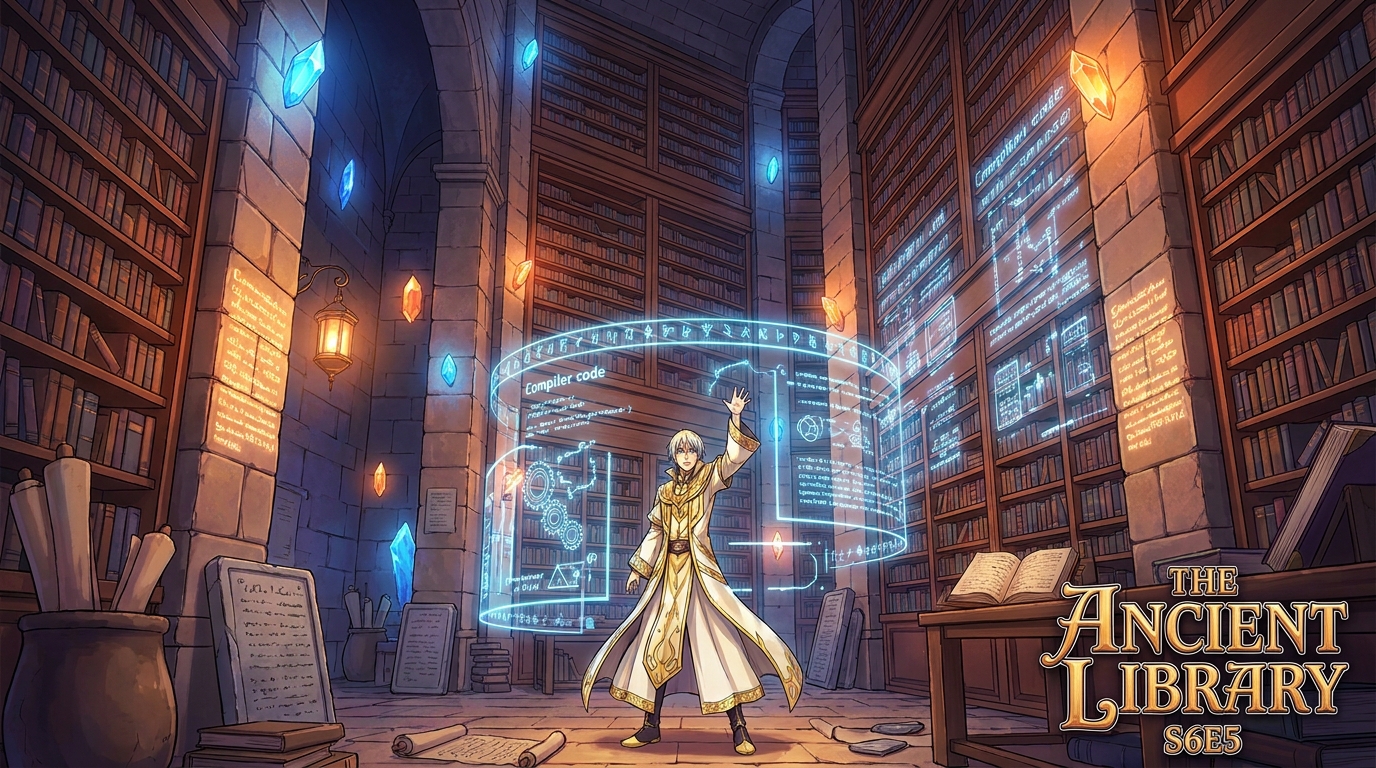
In which our protagonist's apprentice finds the truth about the world's source code, and learns that the original developer was a programmer who lost his family.
The ancient library was a thousand kilometers south, in the place where the corruption was strongest, in the place that the void had not yet reached but was approaching. It was a ruin, a stone structure half-buried in the earth, that had been there since before the kingdoms, since before the churches, since before anyone could remember.
Lian had found it by reading the source code. She had been looking for the truth about the World Root, the truth about the corruption, the truth about Malachar, and the source code had pointed her to a place where the truth was stored.
The team went south. Kenji, Lian, Elara, Calla. Seraphina stayed at the camp, running the Silver Road. They took a small guard, a small crystal network, and Pip's faint spark, in the back of Kenji's mind.
The journey took three days. The corruption was everywhere. The void was on the horizon, a faint shimmer in the air, the absence of code. They moved through the broken lands, the corrupted cities, the places where the world had been deleted and not yet restored.
The library was intact. The corruption had not touched it. The void had not reached it. It was, Lian said, because the library was written into the source code in a way that made it permanent, that made it part of the foundation, that made it undeletable.
They went inside. The library was vast. It was a single room, the size of a cathedral, filled with shelves, filled with books, filled with scrolls, filled with tablets, filled with crystals, filled with every kind of information storage that the world had ever known. The air was cool and dry. The mana was stable. The corruption was absent.
Lian walked to the center of the library. She held out her hand. She whispered: "Function read(target=library, scope=all)!"
The library lit up. Every book, every scroll, every tablet, every crystal, all of them glowing with the same kind of structured magic that Kenji used, the same kind of code that Lian had learned to read. The library was not just a library. It was a database. It was the world's database. It was the place where the truth about the world's source code was stored.
Lian started reading. She read for an hour, then two, then three. She did not stop. She did not eat. She did not drink. She just read, her hand moving through the air, her eyes wide, her face pale.
Then she stopped. She looked at Kenji. She said: "I have found the truth."
"Tell me."
"The world's source code was written, a long time ago, by a man named Malachar. He was not a god. He was a programmer. He was a person, like you, like me, like all of us. He had a family. He had a wife. He had a daughter. He lived in a small village, and he wrote code, and the code became the world."
"A programmer."
"Yes. He wrote the world's source code because he wanted to build a world that would last forever. A world where his family would be safe. A world where his daughter would never have to experience the loss that he had experienced as a child. He wrote the code with love. He wrote it carefully. He wrote it with the same care that you write your spells, with the same care that I write my source code."
"What happened?"
"He lost them. His wife got sick. His daughter got sick. There was no medicine. There was no magic. There was only the code, and the code could not save them. He watched them die. He watched the world that he had built fail to protect the people he loved."
The library was silent.
"He went mad," Lian said. "He went mad with grief. He went mad with rage. He went mad with the realization that the code was not enough, that the world was not enough, that the love was not enough. He decided that the code was wrong. He decided that the world was wrong. He decided that everything he had built was wrong, and that the only way to fix it was to unmake it."
"The corruption."
"The corruption. He corrupted the source code. He wrote the bugs into the foundation. He made the storms and the floods and the droughts and the earthquakes. He made the void. He made all of it. He made it because he wanted to unmake what he had built. He wanted to start over. He wanted to delete the world and write a new one, one that would not fail, one that would not lose the people he loved."
"The world is a grief project."
"The world is a grief project. Malachar corrupted it because he could not save his family. He has been trying to unmake it ever since. The cult, the corruption, the void, the World Root, all of it is part of his plan to delete the world and start over."
Kenji sat down. He looked at the library. He looked at the truth. He looked at the through-line, which had been his spine, his constant, his answer to everything, and he thought: "The through-line is true. Any sufficiently well-defined problem is solvable. But the problem is bigger than I thought. The problem is not just a bug. The problem is a grief. The problem is a father who lost his daughter and decided to unmake the world."
"The World Root," he said. "The piece of source code that Malachar has been searching for. What is it?"
"It is the key," Lian said. "It is the key to the world's meta-code. It is the part that generates the world. If Malachar gets the World Root, he can delete the entire world and start over. If we get the World Root, we can rewrite the world's source code, fix the corruption, and save the world."
"What do we do?"
"We get there first."
# WORLD.md (updated)

## Status
- Ancient library: found, intact, the world's database
- The truth: Malachar was a programmer who lost his family
- The world: a grief project, a corrupted creation
- The World Root: the key, both Malachar and the team are racing for it
- The team: has the truth, has the plan, has the through-line

## Lessons
- The world is a grief project. A programmer lost his family and decided to unmake the world.
- "Any sufficiently well-defined problem is solvable. But the problem is bigger than I thought."
- The problem is not just a bug. The problem is a grief.
- We get there first